Saturday, January 7, 2012

Day 7: January 7th - Sunrise over Storm King Mountain

Sunny, gentle warm breeze, 54 degrees


     Sunrise over the Storm King Mountain above West Point, NY is always different.  Each day is spectacular in its own way.   The valley may be shrouded in fog while the tops of the mountains peak just above the mist.  On other days, the autumn sun paints a remarkable scene with an incredible palette of pastel colors.  Often in winter, the snow blankets the entire topography, and the sun glistens brilliantly off the reflective surface with a cool blue tint.  Today,  the sun was just rising above Cro’s Nest, the mountain to the southeast of Storm King and its shadow crept almost imperceptibly down the valley wall as the sun was lifting above the horizon.  The rich golden hue seemed even deeper than normal this morning, and the warm tones mirrored the balmy temperatures….remarkable considering that we are heading into the second week of January.  It surely was a beautiful commencement to another magical day in the Hudson Valley.

Friday, January 6, 2012

Day 6: January 6th - A Fine Consolation

Partly cloudy, 46 degrees, Calm

     Much of the birding we do is dependent upon reports we receive via the Internet.  “E-bird” has become the life-line for many a birder, especially those of us who like to “chase” rare birds.  E-bird and the New York list-serve have been posting reports of an extremely rare find in New Jersey…..a Common chaffinch.  This colorful finch is quite common indeed in Europe and western Asia, but to find one in the States is definitely unique.  The bird has been visiting a back yard feeding station in Union, New Jersey since December 20th, and for whatever reason, I’ve been putting off the 2 hour trip….until today.  If it has been in Jersey since before Christmas, surely it will be an easy North American lifer for both Sharon and me.  So off we go.

Carolina wren
     When we arrived at our destination, the handwriting was on the wall.  The street curbs looked like the worst mall parking lot on “Black Friday”, a real nightmare.  When we finally parked and walked up to the house where the owners were kind enough to allow birders to come and visit, there were 62 birders, not counting Sharon and me, jostling for position to see the expected Chaffinch.  Whether it was the crowd, the unnecessary conversation, or simply that the bird had finally moved on, we were not going to see this bird today.  We gave it our best, waiting patiently for 2 ½ hours for the bird to materialize, but to no avail.   I did manage to pick up a couple of nice “year birds” in the form of a Ruby-crowned kinglet and a Carolina wren.  But those certainly don’t equal a bird visiting from Eurasia!  This story does have a happy ending, however.

     I began by saying that we birders rely greatly on networking in our quest for new birds.   In my house, I am “king” of computer networking.  My wife, Sharon, however is definitely the “queen” of social networking, and she will always “work the crowd” to find out whatever info is to be had regarding other neat sightings in the immediate area.  Today, she struck up a conversation with a well know photographer who gave us the lowdown on another great find, the Snowy owl.  We plugged in the appropriate coordinates into the GPS and off we went.  When we arrived at our destination, it was only a ¼ mile hike back into the base of the dam at Merrill Creek Reservoir in Washington, NJ.  With the help of a local birder, we were quickly on the owl, a young supposedly female who with a little maneuvering could be seen in the clear.  Distant, yes, but still a clear enough shot to warrant the “image of the day” title.  So, Chaffinch or no Chaffinch, the day was a success with a great sighting.
Snowy owl

Thursday, January 5, 2012

Day 5: January 5th - Ducks in love


Overcast, temps-high 30s, breezy

     One of our local ponds is not dissimilar from most other bodies of fresh water in that you can always count on at least a small population of Mallards to be present.   I thought today might be different in that we have had several nights of rather severe cold with temperatures in the low teens to single digits.  The ducks need open water to feed, and once the ponds are iced over, the mallards move on in search of ice-free water elsewhere.  "Elsewhere" usually means areas of wider expanses of water such as the Hudson River or areas where the water is moving such as the outlet of a stream into a larger body of water.
     Well, today the Mallards were still content to sit it out at Roe Pond in spite of the fact that this body of water was close to 99% iced over.  But….there is an inlet into the pond where an area of about 8 X 5 feet was open.  Whether or not the area was large enough to supply vegetation for the 8 ducks that were present is another story, however.  Each and every car that pulled in to park for a look at the lake drew a crowd.  The ducks quickly left their little pool and waddled over to the car, waiting for a handout.  Obviously, folks often pull into the lot with scraps of bread for the little beggars and they know a good thing when they see it.  If the car windows remained shut and no offering was made by the drivers, however, the ducks were quick to return to their quarters and wait for the next vehicle to pull in.  If you look closely towards the end of the video clip, however, one pair of mallards decided to take advantage of their "time alone". 

      It happened so quickly, however, that by the time the first duck began to return to the pool, the love-birds were all finished and acting as if nothing at all had taken place.  Ah, winter, and love is in the air.  
      The weather promises to get warmer over the next couple of days and the thin skim of ice will quickly disappear, opening up the water once again and allowing the ducks free reign over their dominion,

Wednesday, January 4, 2012

Day 4: January 4th - Shawangunk National Wildlife Refuge

Cloudy, temp – 26 degrees, light breeze

     We head north today to the New Paltz – Shawangunk region.  We have 4 target birds we need to get for the year while we are still in the northeast….. the Red-headed woodpecker, Northern harrier, Rough-legged hawk, and the Short-eared owl.  We began the day at the swamp located at the intersection of Plutarch and Weston Roads in New Paltz. 
     This is one of the few areas in this part of the state where Red-headed woodpeckers can be usually found.  It took a while for the Red-headed to appear today, and in meantime, we had a nice Yellow-bellied sapsucker, several White-breasted nuthatches, Red-bellied woodpeckers, and a Downey or two to keep us company.  Eventually, however, the first of our target species fell and we were off to a good start. 


Red-headed woodpecker

From here, it was off to the Shawangunk Grasslands National Wildlife Refuge in Wallkill.  We knew that to have a shot at the owls, we really needed to get on site about ½ hour before sundown.  We were pretty much right on time, and the three remaining members of the day’s quarry were quite punctual as well.  The Rough-legged hawk was the first to appear, a  “light-phase” bird perched nicely in the open for good scoped views.  We eventually had two more dark-phase roughies as well.  Shortly thereafter, the harriers showed up in good numbers, and the owls were soon to follow.  At one point, we had 9 harriers, a rough-legged and two owls all in view at the same time.  The shot of the day went to one of a Northern harrier as it skimmed past in the waning light of day, close enough to give us a respectable photo.  Cold?  Yes.  But worth every shiver!
Northern harrier

Short-eared owl

Tuesday, January 3, 2012

Day 3: January 3rd - Mine Road

Sunny, breezy and pretty chilly….26 degrees

     Our friends Bobby and Diana who live nearby told us of several recent sightings of Ring-necked pheasants along the roadside of Mine Road in Fort Montgomery.  The area is quite pristine other than the road which winds through the hilly topography.  Popolopen Creek parallels the macadam and along with the grasses and shrubs offers some prime habitat for song birds, game birds, turkeys, and raptors.  
Popolopen Creek along Mine Road
     You can get a feel for this area by watching the video below.
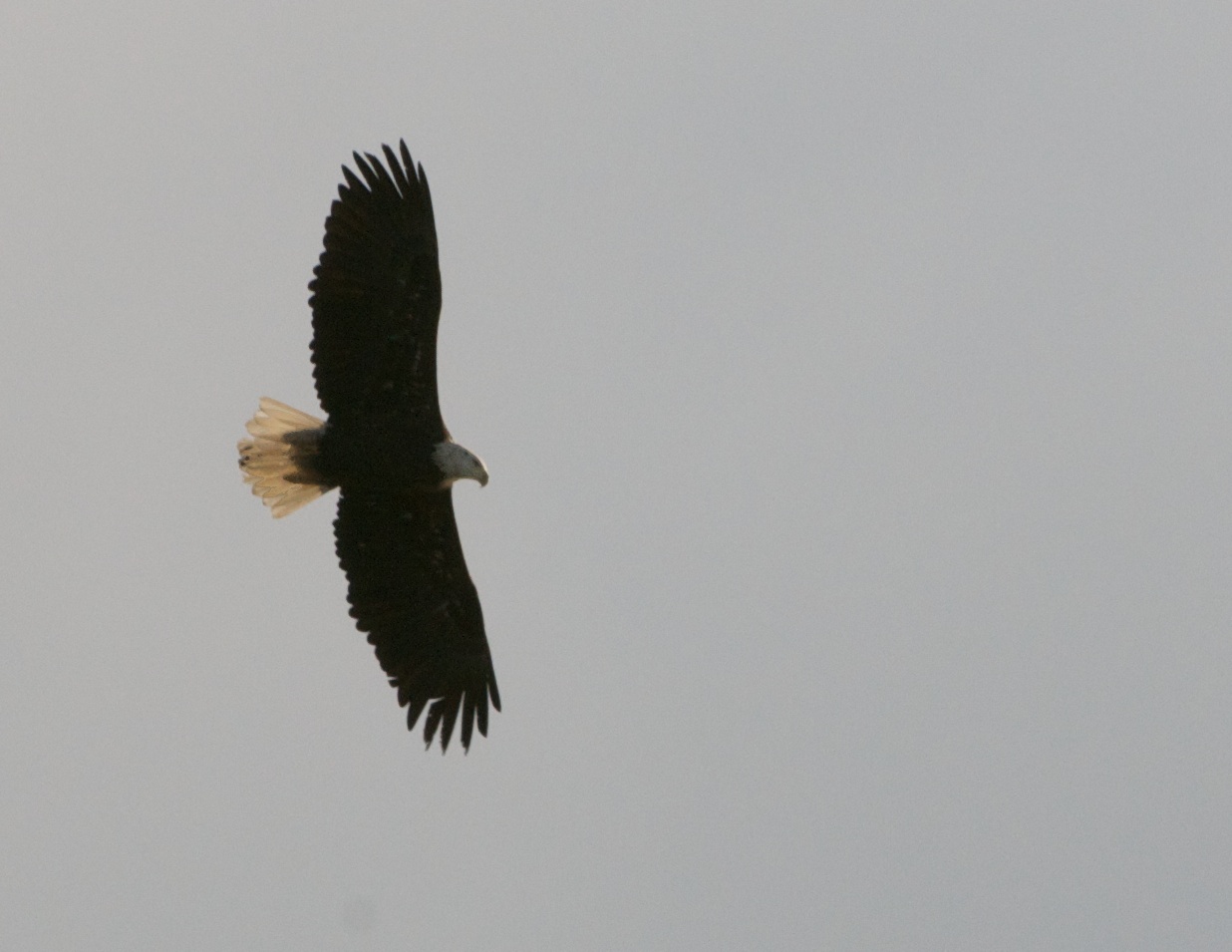
     As I ride along slowly, looking for any signs of the pheasant, I come across a recently struck deer which already shows signs of scavenger activity. This could be the opportunity for my image of the day.  Eagles are in this area and often take advantage of a free meal like this.  I pull my portable blind (AKA Toyota RAV4) off the road at some distance from the carcass and wait patiently.  Within minutes, a juvenile Bald eagle sweeps down across the sky just above me.  I stir with the anticipation of the eagle coming down for a nice close encounter only to have my hopes dashed by a pair of American crows which fly onto the scene and drive my eagle away.  Forty-five minutes more waiting proves to be of no avail, and so today’s shot of the day is that of a dead deer carcass.  Nobody said it was all gonna be pretty!
    (oh yeah...for the record, I never did see or hear any sign of the target pheasant today) 


Monday, January 2, 2012

Day 2 - January 2nd - Winterfowl


Sunny skies, mid- 40’s, breezy
Male bufflehead 
    It feels much more like winter today as the colder air mass headed our way is making its presence known.  There is still no ice on any of the local lakes and ponds, and so it is an ideal time to check and see if any of the winter ducks have arrived.  Each year, we are blessed with a wide variety of waterfowl which makes the Hudson Valley home as long as the water is free from ice.  Rockland Lake happens to be one of the areas where these ducks love to congregate at this time of year, and  I decided to see if I could call upon one or several to pose for today’s “image”.
     Well, the lake produced as promised and I was fortunate to get a nice assemblage of cooperative birds which are now quite used to having joggers, skaters, walkers with their dogs and any other pedestrians walk along the paved trail around the western side of the water.  Buffleheads were by far the most photogenic species of the day, and both male and female “models” came in close to shore to have their portrait done.  These have to rank among the top of the list as the “cutest” ducks on the planet.  We never tire of watching them dive endlessly in search of vegetation off the pond floor.
Female bufflehead
      The most numerous fowl were the American coots with well over 300 scattered around the lake’s surface.  “Birds of a feather flock together” was never truer than it is with coots.  When you see one, you’re going to see hundreds.
Coots
      Some of the most handsome ducks on hand today were the Common mergansers.  Females far outnumbered the males for whatever reason, but there were enough males to afford me a decent shot.
Male Common merganser
Bald eagle
      Where there are ducks, there are bound to be eagles looking for an occasional meal and today was no exception.   A fine Bald eagle was seen far above the water in no hurry at this time to explore the offerings.  Still, if I were a coot, I’d be plenty wary.  And so, today proves to be a fine day in the field.  What will tomorrow bring?

Sunday, January 1, 2012

Day 1: January 1, 2012

Clear skies, calm winds, 52 degrees

     It’s the first day of the new year and the first installment of the “Image a Day” project.  Beginning with today, I will make the attempt to capture at least one image of the natural world for the next 365 consecutive days…and what a day it is to begin.  Here we are officially in winter with bright sunny skies and temperatures in the 50’s.  The winds are virtually non-existent, and it feels much more like the beginning of spring than winter.  But, we had to expect this.  After all, the entire fall was unusually warm with only one freak snowstorm back when the leaves were still on the trees.  The warm weather has left us with an uncommonly low number of song birds visiting us from the north.   Recent Christmas Counts from around the region support this observation with record low numbers.  Will the weather suddenly change and bring us a more typical New York winter?  Only time will tell.
      Nonetheless, today is one of new beginnigs.  The year 2011 was pretty productive with a year list topping out at 330 North American species, 13 more than the previous high.  Today, however, the slate is wiped clean and we start anew.  The honors of First of the Year goes to the Tufted titmouse which was singing its song as I walked by daughter’s dog Lassie around the property.  
Tufted titmouse - First bird of 2012
     The titmouse was soon joined by Bluejays, Downey woodpeckers, House sparrows and a White-breasted nuthatch which looked as if it was just returning from a New Year’s eve outing, dressed in his finest ensemble.
Downey woodpecker
       A ride up to nearby Cragston Lake provided a number of Mallards and a Belted kingfisher for the 2012 Year List, but other than these birds, the ponds were quiet. 
The lily pond at Cragston Lake
     The year is full of promise with a major birding trip to Montana planned for June as well as journeys to such birding meccas as the Everglades, Adirondacks, Magee Marsh in Ohio, and an international jaunt to New Zealand and Australia.  I’ll try to post the images and notes on a daily basis, so all our family and friends can “join” us on our trips.  Here’s looking forward to a Great New Year!

Wednesday, December 21, 2011

The New 2012 Daily Blog

Golden eagle over Bear Mountain, NY
     Five years ago in 2006, I began a project in which I vowed to create a journal in which I would capture at least one nature photo per day for the entire year. (No fair going to the archives for a new photo....each must be taken on the day it is posted!)  On New Year's eve, 365 days later, I photographed and printed out my final entry.  Well, I'm ready to repeat the challenge of a photo a day with a new twist...I'll plan to post each and every entry for the entire year on my blog.  The new format will allow me to capture and post digital movies as well as stills.   I know from the last attempt that there will always be the possibility for an occasional roadblocks that get thrown into the path, but I'll do my best to capture an image for that day.  Hope you'll join me on the journey which will include such already scheduled venues as the Florida keys, Wyoming, and even farther away from home, Australia and New Zealand.  Hope to see you on January 1st.  Have a great holiday.
                                           

Saturday, December 3, 2011

Winter in the Dacks

Whiteface Mountain

     Sharon and I are lucky enough to be attending our grandson's hockey tournament here in Lake Placid this weekend. It's been great as the weather has been chilly but without an abundance of the white stuff, our team is playing in the finals tomorrow morning, and we've been able to sneak away between games and hit nearby places in the Adirondacks that we love to bird . So far, we've visited Bigelow Bog, Lake Placid and Whiteface Mountain. Even though we only get away for an hour or so each time, it's been enough to bag two new year birds and an elusive lifer for me, the Boreal chickadee.
Boreal chickadee

      There were several Boreals at Bigelow Bog sprinkled in among a larger flock of Black-capped chickadees which were all in resplendent fresh Black, white and gray plumage.

Black-capped chickadee

      Siskins were found along the road up to the gatehouse at the entrance to Whiteface Mountain drive.  We had searched the other areas pretty thoroughly with no results until we found this pair.
Pine siskins

      The Red-breasted nuthatch has been a nemesis for us this year. We had the white-breasted and the Brown-headed, but I really was beginning to believe that we'd go the entire year without this bird.  Fortunately, the first edge of bog and coniferous forest that we checked produced the nasal note of this red-breasted and eventually fine views.
Red-breasted nuthatch

      What a great weekend all the way around! We head back to Orange County tomorrow after the tournament finals and hopefully a gold medal for the boys.  Basically, we were all winners this December weekend.

Monday, November 21, 2011

Cape Ann, MA

Brace's Cove, Gloucester
     One of the signs that the holiday season is quickly approaching is the trip to Cape Ann in Massachusetts to see the wintering birds along the Atlantic coastline. Our targets for this annual outing include loons, alcids, wintering seaducks like Long-tails, eiders and Red-breasted mergansers, and THE bird we all head north for, the Harlequin duck. Our main quarters for weekend are in Gloucester, a beautiful seaport steeped in a tradition of commercial fishing and sailing. Visitors flock to this year-round resort just to bask in the embiance of the rugged coastline. The headlands serve to afford us birders with an outstanding vantage point from which we can survey the protected waters of the harbors.

Common eider
       Northern gannets plunge into the frigid waters from high above while the Common eiders swim in small groups closer in to the beaches. This is definitely a location where spotting scopes are a necessity as many of our quarry prefer to remin farther out from the shore. It's a challenge to distinguish between the Red-throated loons and the Red-necked grebes as they bob in and out of view while riding the surf. I often find myself excitedly training my glass on a potential Black guillemot (not so black in winter!) only to discover that in fact it is another of the myriad of buoys marking the locations of the lobster pots scattered upon the harbor floor. While the lobsters are foraging in the depths, the seals choose to take advantage of the unusually warm temperatures and are seen sunbathing on the rock outcrops peeking up above the surface of the water.
Harbor seals
      In the 2 1/2 days we spent skirting up and down the coast, we managed to see most of what we came north for. Highlights along the rocky shoreline included Horned grebes, many Common eiders, Common and Red-throated loons, all three species of scoters, the Black guillemots, Long-tailed ducks, and of course the most strikingly handsome of the entire group, the Harlequin.
Harlequin duck
      Further inland we were treated to pleasing looks at a lone Snow bunting at close range, and a field of Canada geese sharing their turf with a half dozen Snow geese with a couple of Blue morphs. Best of all, one handsome Barnacle goose was situated squarely in the midst of the crowd.
Barnacle goose among Canada geese
      And so, as we headed back to SE New York, we were pleased to have been able to add a number of new birds to our "year lists" and in the process to have unofficially begun the 2011 holiday season.

Saturday, October 29, 2011

South Carolina Birding

Huntington Beach State Park
     We've made our annual trip down to Myrtle Beach to spend a couple of weeks birding and golfing with our friends from the New York "north country".  Each year, we join around a dozen folks....some who love to play golf, some who love to bird, some who love the beach and some who just love this part of the country.  Sharon and I usually come down a few days early and get some serious birding in at Huntington Beach State Park, one of the finest refuges in the state.  We found things much as we had hoped for with the reported Roseate spoonbill and Wood storks still on site.

Wood stork
Roseate spoonbill
       We also found a good number of waders and shore birds which took advantage of the extensive mud flats exposed during this new moon low tide.  Never saw the tide this low in Huntington Beach and we certainly had great numbers and varieties of the birds.....Baird's, Black-bellied and Golden plovers, Sem-palmated sandpipers and plovers, Spotted sandpipers, Dunlins, Dowitchers, Least and Western sandpipers, and more.   We were somewhat surprised to find a good-sized flock of avocets working in concert to scour the floor of the shallow fresh water impoundment.

     Plenty of herons (Great blue, Great egret, Tri-colored, and Snowy) as well as many Clapper rails which were heard, but only one seen.
Snowy egret
      We added a year-bird while visiting Brookgreen Gardens which are located across Route 17 from Huntington Beach.  Part of the gardens is a small but well maintained zoo.  As we were walking through the gardens, a fellow birder told us that he had come across a Barred owl tucked away in the forest near the Alligator pen.  We've often had good luck birding in zoos and today was no exception.  When we arrived at the gators, Sharon located the owl as described.  Nice opportunity to find the bird!

Barred owl
     Regarding songbirds, we found that the male Painted buntings had headed south, but there were still a few females around.  A beautiful Yellow-throated vireo as well as Yellow-rumped, Black and white, Northern parulas, Palm and other warblers were present but somewhat tough to find.   One of our most memorable sightings was late in the day while we were watching at least 200 dunlin all busily probing the mudflats.  Suddenly, they vacated the area with explosive activity.  We figured something had triggered this sudden movement and sure enough, a Peregrine falcon came soaring through the area about 3 feet above the water.  Not sure how he made out regarding his attempts to find an early dinner, but he certainly was making a gallant effort at doing so.  We still have a few more days here along the shore and we will add to our list for sure.  Great friends, great weather, great golf courses with a concern for keeping it "green", and great birds.  What more can we ask for?

Monday, October 24, 2011

Block Island


     Earlier this month, Sharon, friend Joe and I all had the pleasure of visiting Block Island, RI with Connecticut Audubon.  The island has a great reputation for birding during the fall migration and like the other islands we have birded, a lot depends upon the prevailing winds.  We left with our guides and fellow travelers from Port Judith on the last day of September and almost immediately had our first Common eider of the year.  The rest of the ferry ride over to the island was fairly tame with mostly cormorants and Herring gulls in view.  The forecast for the weekend was mostly cloudy with periods of showers and chilly temps.  The weathermen could not have called it further from the truth.  We had great sunny skies and warm temps in the 70's throughout most of the weekend.  Unfortunately, the winds were not what we had hoped for with fairly steady breezes coming up from the south.  Nonetheless, the birds were still plentiful even if we did miss the hoped-for "fallouts" of migrating warblers.  To describe the term "plentiful" as used here, I can only mention that at one point I had Cape May, Parula, and Blackburnian warblers all in the same bins view at the same time.
Yellow warbler    
       No complaints from this birder or any of the others in this regard.  One of our highlights of the trip was a reported Nighthawk called in from one of the other Audubon groups on the island.  Block Island is only 12 miles or so long, so when a report comes in, it's only a matter of minutes before we can be on site and in hot pursuit of the bird.  That being said, Nighthawks are masters of evasion and tend to "hide in plain sight".  The bird was doing what Nighthawks do during the mid-day hours......sleeping on the limb of a tree and blending in almost perfectly.
Common nighthawk
       Unless the bird moves, it will most often go undetected.  The bird is generally not be in any hurry to vacate his sleeping quarters during the daylight hours, and therefore we expected he should be pretty much in the location reported for an extended time.   Well, our directions to the bird were quite specific and we did eventually find the bird after more than a hour's search.
Nelson's sparrow
     Another target bird was either (or both) of the "sharp tail" sparrows.  Guide Andy knew of an area where the birds have been seen in the past and so we made a concerted effort to try and locate one of the birds.  Sure enough, after some serious searching, a Nelson's sparrow was located and we all had excellent albeit a bit distant looks.  Later in the trip the Saltmarsh was also found....two more year birds!


Yellow-billed cuckoo
     The final tally for our trip was a little over a hundred species with a nice Yellow-billed cuckoo, a number of raptors, and the warblers being the finest sightings beyond the Nighthawk.  Our leaders, Andy, Joe, and Priscila, provided us with expert sightings in a beautiful setting and we will surely return with the hopes of even better wind conditions.  Can't imagine it getting much better than what we had on this weekend!

Tuesday, October 11, 2011

Cape May, The Fall Migration

Sharp-shinned hawk
      Cape May, NJ is without question one of the premier birding hotspots on the east coast.  In the fall, hawks by the thousands fly overhead in an attempt to stay over dry land for as long as possible on their journey south.  Warlbers are also funneled down to this point of land which is the final dry spot before venturing out across Delaware Bay.  The birds will spend some time here, fattening up a bit and waiting for the perfect northwest winds to help carry them across the bay.  Even though the winds were not perfect on this beautiful warm fall weekend, the birds were still plentiful.  Warblers, vireos, raptors, thrashers, creepers, ducks of many varieties and more were all to be had for those who had do nothing more than look around.
Yellow-throated vireo
      We were up on each day before the sun rose in an attempt to get the birds when they first become energized after spending the night in the protection of the foliage.  When the sun rises and begins to warm the vegetation, the insects become more active.  When the bugs get going, so do the birds which feed upon them.  Warblers and sparrow can be found flitting along the ground, at mid-level of the trees, and up into the highest levels of the canopy.  In summer, the show usually quiets down as the morning wears on, but here in fall, the activity just keeps going as the birds seize the opportunity to get a free meal in preparation for the continuation of their journey to Central and South America.

Cape May warbler

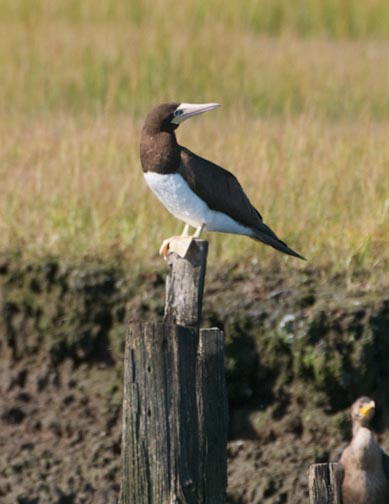
     Our best spottings of the weekend were some birds who have traveled further than normally would be expected.  A fine Brown booby, a bird normally found around the extreme southern tip of Florida past the keys.  For whatever reason, this bird has found New Jersey and for the time being is quite content to spend some time with the other tourists.  The bird has been here for over two months now and nobody knows when the bird will head back down south.  For now, it makes for some rare viewing for us northern birders.
Brown booby
    A Cackling goose also showed up this weekend.  This smaller version of the Canada goose is distinguished from its larger relatives by size and by a small stubby bill.  Again, this is not a goose common to our area.
Cackling goose in front of larger Canada goose
     And finally, to add to the 115+ species we found at Cape May this weekend, a female Eurasian wigeon from the Old World has made a showing.  While these birds are now known to nest in North America, they do make an occasional appearance here in the US and today, we are privileged to be able to watch here swim among here American counterparts, the American wigeons.  All in all, the Cape has produced what she promised....three days of wonderful birding in wonderful warm October weather.