Monday, March 17, 2014

More signs of spring

     We continue to find new signs of spring as we inch towards the official start of the season later this week.  Our weekend trips out to Viera Wetlands and Tosohatchee Wildlife Management Area produced several images indicative of avian amore.  First, at Viera, we found that while in some cases the young of the Great blue herons had already fledged and the nests were bare.  Others palm tree trunks, however, were serving as platforms for the newer nests and in at least one case, we could actually see the eggs of the herons beneath the brooding mother.  Look carefully at the image below to see the eggs poking out from her side.


       Another mom tending to her nest was this Sandhill crane.  As we watched, she arose from her "nursery to be" to roll one of the eggs she was tending to.  Here again, if you look carefully at the next image, you will see her gently moving the egg about with her long bill.  There was probably a second egg in the nest as these cranes generally give birth to a pair of at a time.  Couldn't say if this was the mom or dad as both take turns tending to the incubation chores.  The eggs generally hatch in just about one month's time with the chicks leaving the next within a day or so of being born.  They will then hang out with the parents, learning how to forage and hunt for themselves.


       Some eggs have already been laid, incubated and hatched.  On the outskirts of Merritt Island National Wildlife Refuge,  Sharon and I found a Great-horned owl occupying an abandoned osprey nest several weeks ago.  This weekend, we were thrilled to see that the mom was no longer sitting on the nest.  She had moved over to a nearby dead tree limb while the nest was now the home to a newborn owlet.

      I must end up this installment with a caveat that all was not exactly joy, peace, and harmony in the avian world of love and child rearing.  Territorial battles are common as birds vie for nesting sites of for the attention of an attractive female nearby.  The next series of shots was taken along the edge of the "Click Ponds" at Viera Wetlands here in Florida.  As several female Boat-tailed grackles looked on with apparent "half-interest", two males with hormones raging engaged in a battle royal in the shallow water of the pond.  At first, there was posturing such that you could almost imaging one of the grackles calling out the second with some phrase like, "You want to mess with me?"


     Suddenly, one of the birds made the first move, pinning the second down in the water.


     This was followed by and explosion of roiling water as each bird violently tried to get the better of its adversary.  


     Within seconds, the battle was over with one of the birds beating a hasty retreat.  When all was said and done, the victor looked around at the audience of females which had been watching only to see that they had all walked away disinterestedly.  All for naught!  Sooner or later, I'm sure the winner will find his true love and will sire offspring of his own.  Apparently, today was not the day.

Wednesday, March 12, 2014

Spring is on the way

With the official beginning of spring just around the corner, signs of the season are popping up all around Florida.  While weather conditions back home in New York would suggest otherwise, here in the "Sunshine State", the avian community is gearing up for the time of year when seeking out territory, setting up nests, and mating are paramount.  Some of the birds have gotten a jump on the season and are already rearing their young.  The handsome Great blue heron family located at Viera Wetlands is obviously well on its way.


       At the same location, a pair of Anhingas was set to follow suit with their nest construction well under way and Mom possibly incubating her eggs.


     Meanwhile, over on the Gulf Coast,  a new cast of characters was moving in as birds which left their wintering grounds down in Central and South America and are heading into Florida and points north.  One of our favorite first signs of spring includes the Swallow-tailed kites.  This bird is unquestionably the most elegant of our birds of prey.  It's flight is thrilling to watch as it "glides through the air with the greatest of ease".  The nests are built in the highest of trees and are lined with lichen and spanish moss.  It would appear that this gorgeous specimen at Corkscrew Swamp Sanctuary was heading back to its own nest with some of that material in tow.


     While birding the west coast of Florida, we also made a special effort to find one of our favorite targets, the Burrowing owl.  This slim little owl is in danger due to habitat loss.  These Florida birds have to excavate their own tunnels in what is left of open flat sandy ground and this pair has set up home in a vacant lot in Marco Island.  For those of you familiar with that area, you know it is highly developed and the use of these vacant lots by the owls is about the only suitable territory in the area.  While nocturnal during much of the year, the owls become much more visible during the breeding season, often perched out in the open for us lucky enough to be nearby with a camera.


     Finally, we'll end this installment with a photo of one of my personal favorite signs of spring, the Northern parula.  We often hear its distinctive call before we notice the bird, but we soon see it in abundance flitting through the trees low to the ground.   One of our most colorful warblers, we are always thrilled to welcome this harbinger of the season.


Saturday, February 8, 2014

Birds in flight

     Well, the count for photographed birds as of today (2/8/14) for this year is 93.  The weather here in  Florida has been less than ideal for avian photography, so I'm pretty happy with the numbers up to this date.  I've been concentrating my efforts on capturing birds in flight.  I've cranked up the shutter speed, trying to keep it at no lower than 1/1000 sec and preferring to go at 1/1600 or better.  That being said, the brighter the skies the better.  I've also been opting for the Auto setting on my ISO settings, meaning the brighter the skies, the sharper the image.  It also means that I'm not losing as many shots as I did in the past by having the ISO set too low.  With the newer bodies (I'm now using both the D300s and a newer D7100), higher ISO settings still deliver decent shots where as in the past, high ISO meant more grain or "noise" in the photo.  Sorry to bore the non-photo enthusiasts with the details, but figured I mention this for those interested in the settings I'm using.

       In the past couple of weeks, I've been fortunate enough to capture several of my favorite birds doing what they were meant to do.....fly.  The first is a Barn owl which has been my "nemesis bird" for many years.  Not only had I not photographed one in the wild (I had decent shots of captive birds in flight), but I need this bird for a lifer!  Fortunately, while out on a trip with fellow birders from the one of the local Audubon clubs, I was able to grab a few frames of this beautiful owl as it exited an old building on the grounds of the Lake Apopka Preserve here in Florida.  The light was subdued, but I was able to shoot at 1/1000 of a second with the shutter wide open.  The auto ISO set itself all the way up to 1600, and yet there is remarkably little "noise" even though the image was cropped and enlarged.  Have to love the new technology!


       My next favorite shot of the past two weeks was taken along a gravel road through Shiloh Road on the property of Merritt Island National Wildlife Reserve.  I had been searching for the American avocets we had previously seen while birding this venue.  It was getting later in the day, so the light was at my back with the waters of the marsh in front of me.  No sooner had I found a flock of around two dozen birds of the desired species along with a good number of Blue-winged teal, then the entire group exploded into flight.  I looked for and quickly found the reason for their quick departure.  A young Bald eagle had flown overhead, putting the fear of the bird God in their hearts.  I quickly got on two of the birds and fired away.  With much better light, I was able to shoot at 1/1000 of a second with a much preferred low ISO of 160.  The aperture was a bit smaller, affording me more depth of field so that both bird heads were in sharp focus.


     I still had time to back off on the zoom to capture not only the avocets but also the beautiful Blue-winged teals flashing their brilliant blue upper wing coverts.  It's not often you get the opportunity to capture striking images of two gorgeous birds in the same frame.  Just have to be in the right place at the right time.


          One of the great advantages of capturing birds in flight is that no only is the subject so much more interesting and dynamic, but also you are often afforded a better look at often latent patterning hidden when the subject is at rest.  The next image is an example of the case in point.  This shot was also taken on the same day at the same location as the previous ones.  The subject is a Bonaparte's gull, a species which has made a sudden incursion into the area.  In the shot of the bird shown here, the patterning on the wings, not normally seen at rest, is obvious.  


       While the weather has not cooperated over the past week or so, the forecast is for brighter skies and warmer temperatures here in Central Florida.  Stay tuned and I'll bring you the latest updates on our newest quest.


Wednesday, January 22, 2014

New beginnings.....

It's the beginning of a new year, and as has been my habit for the past number of years, I like to take on a new self-imposed challenge at this time.  This year is the "Year photo list".  I've decided to see how many birds I can photograph in a year's time.  My main thrust will not just be the image, but to capture a more dynamic image of each bird.  Rather than a "field guide" portrait of a Sanderling like this earlier shot.....

     the newer version will attempt to be more of a documentary, portraying some aspect of the bird's life activities.  I am totally guilty of imparting human emotions on my subjects, even though I taught against this practice for years as an educator in Environmental Sciences.  I've spent too many years in contact with the avian world to totally ignore behaviors that make you ask, "What was that bird thinking?"  So when I captured this year's new Sanderling photo, I could hear the sanderling on the right asking itself about the strange actions of it's partner in the surf.


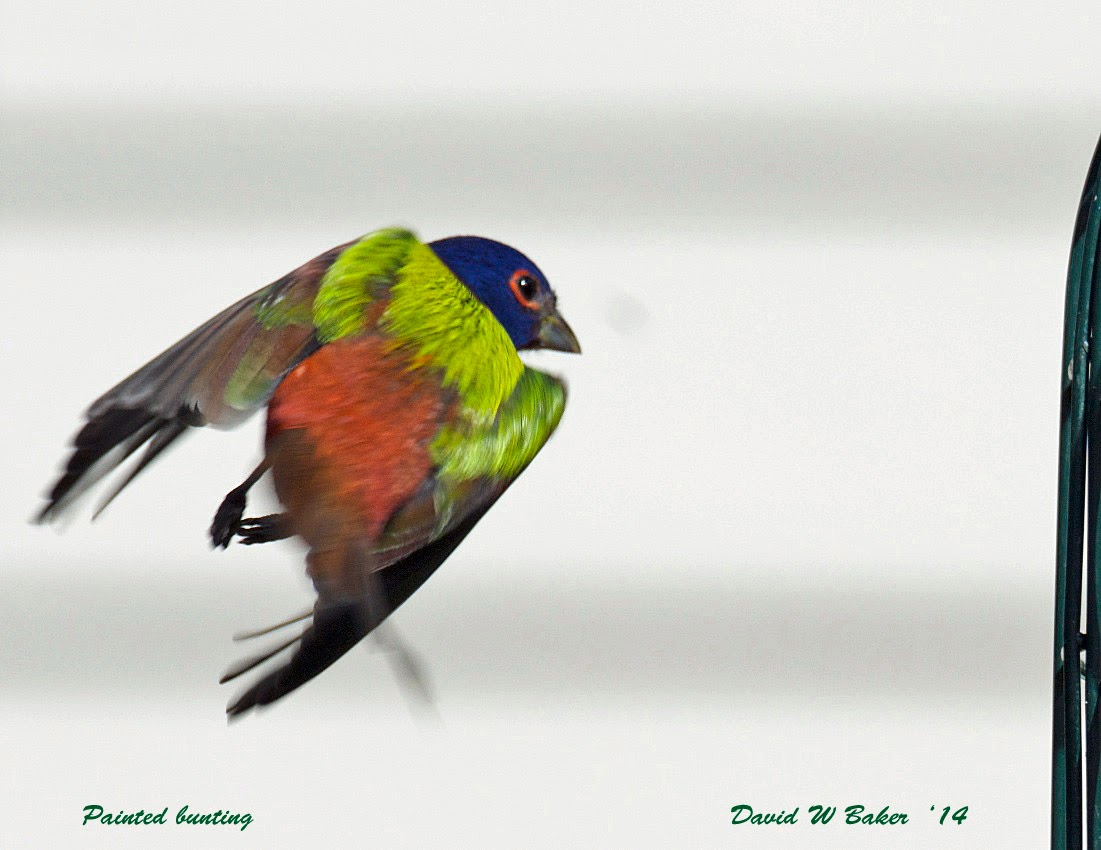
       The second challenge will be to capture more images of birds in flight.  One of the toughest shots I've found is to get a Painted bunting away from the feeder.  Even worse, try capturing one of these beauties in flight.  And so, this addition to the new "Photo Year-list" was a welcome triumph in my digital world.


     Capturing birds-in-flight has become a bit easier for me as I recently acquired two new pieces of equipment.  The new 80-400 mm Nikon AF-S lens has much faster focussing capabilities and paired with a new Nikon D7100 body, I find it much easier to capture decent pix (proper settings being the key).  This latest flight shot of a Laughing gull over the pier at the Naples Beach in Florida is an example of the shots I hope to gather this year.


       And so, I'll be posting updates throughout the year as to how many species I can capture will sample images.  For more images, you can visit my new Flcker site at http://www.flickr.com/photos/111343143@N02/ for a more complete collection.  Meanwhile, as of today, January 22nd, the count stands at 70 species photographed since the beginning of 2014.  I hope you'll follow along during the course of this year and that it will prove to be an exciting year of  birding for all of us.

Snowy egret


Thursday, December 12, 2013

Winter birds 2013

     Technically, it's not quite winter yet.  Another 9 days of fall will elapse before we head into the deep chill here in the northeast.  However, with snow on the ground and temps in the 20's, it sure feels like winter regardless of what the calendar says.  We've had a surge of Snowy owls throughout this part of the country this year adding to the wintery aura, and I decided to head over to one of my favorite spots for locating a number of owl species…..Great horned, Long-eared, Short-eared, Barred, and Eastern screech.  Several years ago, a Snowy appeared on the same site, the land fill of Croton Point Park.  I'd hoped to get another look, but alas, there were no owls to be found on this day.  I did find one species of thrush which is known to be a late (very late) migrant, the Hermit thrush.  He was most cooperative and was easy to photograph from the warmth and comfort of my RAV4.


      Winter ducks, the Buffleheads, were also on site to add to the portfolio as were a number of quite vocal American crows.


       When I think back to all the "winter birds" we've had over the years, it reminds me of what an exciting season this is up in this part of the country.  It's the main reason we don't head south until the winter is well under way.  I' put together a short slide show set to the beautiful music of Tim Story.  I took one photograph for each day from December 1st through January14 when we usually vacate the cold winds of winter and migrate south to the warmer climes of Florida.  Each day is represented by one image I captured on that day over the course of 7 years.  I'd like to share this with you as kind of an early Christmas present from me to you.  Rather than try to upload it in it's entirety here on the Blog, I'll direct you to the site where I've posted it on YouTube.  I hope you enjoy it.  Have a blessed holiday season!

         To view my "Images of Winter" click on .youtu.be/XH355_VCX_k

Wednesday, November 27, 2013

Mia Culpa

Regrets, I've had a few.  Most of all, letting this blog lapse for such a long time has worn on me and now it's time to get back to business.  Lots of "stuff" has been going on, but I'll not bore you with the facts or excuses as to why the void has existed for these past several months.  Let's just say, it's time to move on.

     My newest project for the upcoming year will be a "Big Photo Year" with the goal being the capturing of at least 350 species on "film" from January 1st through December 31st of the calendar year 2014.  The ground rules will be simple…..no old photos allowed.  Only images which are readily identifiable as a specific species will be counted.  The shots won't necessarily have to be "great", but I certainly will make every effort to make each and every shot as worthy of publication as possible.  I've had year-lists for at least a decade now and I do keep a life-list as well as a photo life-list.  But the challenge here will be to see how many species I can collect in one single year.  Between now and January 1st, I'll start planning on places to visit to get the most diverse collection of birds to photograph.    As I move along, I'll post interesting shots of places I plan to revisit once 2014 begins.

       One such place will certainly be the sod farms of Orange County New York where I captured this less than brilliant but fine for documentation purposes image of a Snowy Owl. It was overcast, snowing, and the bird was distant, but nonetheless, you can tell it's a snowy.  These birds are not common to our area and would be a welcome addition when trying to amass a decent number of species for the year count.  Keep your screens tuned to natdigital.blogspot.com and I promise not to leave you hanging.

       The Snowy owl of Skinners Lane, Pine Island, NY  captured on 11/25/13:


Monday, August 26, 2013

2013: Week of August 18th – 24th


Bountiful butterflies

       More visuals than text this week as the butterflies are out in full force and in truth are soooooo much more easily photographed than my usual avian fare.  All of today’s images were captured at the butterfly garden at Stonykill Environmental Farm in Wappingers Falls.  The beautiful sunlit gardens were as attractive to this photographer as they were to the butterflies and I ended up spending a fair amount of time wandering through the beds and maneuvering around to get just the right lighting conditions and hopefully finding those specimens that were not too much the worse for wear.  Below is the collection of images from this day’s outing.

Great spangled fritillary

Pearl crescent pair

Tiger swallowtail

Pearl crescent

Gret spangled fritillary

Black swallowtail


Monarch butterfly


Monday, August 19, 2013

2013: Week of August 11th – 17th


Shorebird migration
     
       We spent two days at two excellent habitats in search for migrating shorebirds.  It’s the middle of August, and the migration of these birds should be just about peaking.  Last week, we spent some time in Brigantine Unit of the Forsythe National Wildlife Refuge in Smithville, New Jersey.  Already, it seemed, many of the migrants have moved through.  The Dunlin which were so profuse a couple of weeks ago were not to be found and the Dowitchers seemed to be diminishing in numbers as well.  Others, however, were here in the northeast in big numbers.

       Among those were the Semi-palmated sandpipers which we found by the thousands as the Brig.  This week, however, we visited two other areas of note….. White’s Bogs, where last week we had the Scissor-tailed flycatcher, and Jamaica Bay Wildlife Refuge. 
 
White's Bogs, Pemberton, NJ
       At the bogs, we found a nice number of Solitary sandpipers (not so solitary after all!), good numbers of yellowlegs, and quite a few Short-billed dowitchers. 


The other bird of note at the bogs were the large numbers of Gull-billed terns flying about in large flocks.  It is often somewhat of an arduous task to be able to locate these birds, but this week, they were the default tern at White’s Bogs.  The birds exhibited a great deal of social behavior, working in concert as they hunted the surface of the bog ponds.  What a beautiful sight to see the large numbers flying as if the entire display was choreographed by an avian Twyla Tharpe.

       We were hoping to locate some Pectoral and Stilt sandpipers at this site, but our survey of the property came up empty.

       Later in the week, back in our home state of New York, we checked out what has always been a hotspot for finding migrant shorebirds, Jamaica Bay Wildlife Refuge.  Last year’s “Superstorm Sandy” devastated the refuge, breeching one of the dikes which isolated the West Pond.  There were far fewer birds than we have come to expect at the refuge this week, and we could not help but wonder what the future holds for the area.  How long will it take, if ever, for the refuge to once again become the magnet it had been before being ravaged by the storm.


       Still, we found some fine birds to hold our attention.  Several first year Black-crowned Night-herons were found including this one which was either bathing or simply keeping cool on this warm day by spending and extended period of time half submerged in “Big John’s Pond”.  Being close to the photo blind made for an excellent opportunity to shoot this youngster.   A group of Glossy ibises were also visible from the blind and remained perched above the Night-heron.


       Short-billed dowitchers were also common and were not afraid to come within great photo-op distance.  These seen below happened to be feeding in the reflection of a mute swan, making for an interesting backdrop.


       Oystercatchers were moving through and we counted over thirty on one sandbar out in the bay. 
 The Stilt sandpiper we had sought down in Jersey was finally found here in Jamaica Bay and gave us nice extended looks as did a less common bird here in New York, the American avocet. 

Stilt sandpiper
       A far more common bird (although not found in great numbers in the refuge today) is the Semi-palmated plover.  This bird gave us a great show as it bathed no more than 30 yards from us in the shallows of the north end of the East Pond.  In an effort to really shake that excess water off, the bird made a vertical leap at one point and shook vigorously in mid-air.  I had the camera trained on the bird at the right time and captured the acrobatic move.


       Well, it is August.  And after a few weeks lull, things are picking up once again as the first waves of fall migrants begin to move through Southeast New York.  We’ll keep an eye on the continuing movement of the shorebirds as well as the “confusing fall warblers” in the upcoming weeks.  Watch for upcoming reports on our finds.

Friday, August 9, 2013

2013: August 4th – 10th Jersey Scissor-tail


        We are wrapping up another enjoyable week with our son’s family here in Long Beach Island and now await the arrival of our daughter and her family.  We’ve been able to squeek in a little birding time between beaching, miniature golf, fishing, and so on and in fact had a successful chase after a Jersey rarity, the Scissor-tailed flycatcher.


       This flycatcher should be in the south-central region of the country during the summer months and around this time of year should be gathering in large flocks to begin their migration to Mexico and points south.  So, why did this bird decide to make an appearance in central New Jersey?  Only God and the bird know.  In any case, the bird chose some pretty nice digs to settle into, making her summer home the cranberry bogs of Brown’s Mills. 

       Having noticed the reports of this elegant flycatcher on eBird, Sharon and I took a brief trip northwest to White’s Bogs, an historical cranberry producing operation about an hour from where we are staying in LBI.  We found a group of Jersey birders on site, but they had already seen the flycatcher and were off on another quest.  We asked where we might be able to locate the scissor-tail and were given explicit directions to “Bog 5” where the bird has been recently sighted.  We were rewarded for our efforts in no time as we drove up to the bog, got out the scope and had the bird fly in and land on a sprinkler head.  As I went for the Nikon, the bird left as quickly as it had appeared and I figured I might have last my one chance for a decent shot at the quarry.


         We continued to scout out Bog 5 and surrounding areas with sightings of other flycatchers but not the scissor-tail.  Finally, after another hour and a half, we returned to said bog and found the desired bird perched out in the middle of the bog.  As luck would have it, we were blessed with brightening skies as I began to shoot.  After a day of misty overcast conditions, the timing could not have been better.  Shooting from the portable blind known as the RAV4, I was able to get better and better shots as the bird flew in closer and closer.  Eventually, he departed, but only after giving us a great look for an extended time.


Semi-palmated sandpiper
        We ended the week with an afternoon down at Brigantine NWR.  We met a friend of ours who we bird the Brig with each August and headed out onto the wildlife drive in the heat of the day.  Mid-day in mid-summer is not the greatest time for birding, but we did OK with about 40 species.  We noted once again how the cast changes from week to week as we head towards fall.  Two weeks ago, it was all about the dunlin.  Last week, the dowitchers took over.  This week, it was thousands of semi-palmated sandpipers that dotted the mudflats. 

       Probably the best shot of the day was of the grand Caspian tern which we found hunting over the first impoundment.  We watched a shot for at least 10 minutes before leaving the bird behind, still plunging into the depths for its lunchtime meal.


        Other terns we found on site included the omnipresent Forster’s terns, a few Least terns, and several Gull-billed terns.  The usual assemblage of herons and egrets were of course on-site as well and this little snowy flew by to check us out as we drove around the impoundments.


       Finally, we had a nice comparison of two of our more common "peeps" which were found together on the jetty off of South 31st Street in Beach Haven.  Both size and plumage differences were evident, but of course the most obvious difference was the bright yellow legs of the Least as opposed to the black legs of the Sanderling (actually a bit too large to be a true "peep")  The Least is one of our really long distance travelers and is likely to be headed down to South America in the immediate future.  We'll keep an eye out for him on the jetty.

Least sandpiper

Sanderling

       We’ll keep track of what develops down here over the next week or so and keep you informed via the blog.  Stay in touch!

Saturday, August 3, 2013

2013 - Week of July 28th – August 3rd: Back on the Plains


South Jersey Coastal Plains, that is……

       Can’t get away from the flatlands lately.  After a week out on the great plains of North Dakota, we find ourselves birding the coastal plains of south Jersey.  As we wend our way through the sultry heat of the summer season, we find subtle changes in the natural world.  Young baby birds are slowly maturing and becoming more independent (to a degree).  Small flocks of birds are seen moving south.  Signs of initial migratory movement, or did we just happen to see them when they were flying in that general direction?  When we see groups behaving this way, like the Cedar waxwings flying in mass with a seemingly definitive purpose, we assume migration.  We also found a collection of Tree swallows which had set in for a little rest among the reeds of the marsh.  Once nesting is complete, these birds become very social.


       The tree swallows we saw today showed signs of molting, and while most birds do not molt during migration, tree swallows are in the select group which do.  After nesting, groups of these swallows will begin migrating towards Florida and points further south by way of a series of short trips down the east coast, moving in units of up to 200 miles from one large marsh to the next.  These marshes provide a great deal of food in the forms of bugs, and believe me, if you have ever been in the Brigantine NWR in July and early August, you know what we’re talking about.  We found it necessary to bird from the car with the windows rolled up in order to prevent the little green-headed monsters from extracting their pound of flesh as we moved through the wetlands. For more interesting facts on these wonderful swallows, visit http://www.treeswallowprojects.com/cafter.html.

        Other products of the recent nesting period which we had the privilege of seeing this week included Clapper rails, American oystercatchers, and fluffy little Common yellowthroat chicks.
 
Clapper rail
Juvenile American oystercatcher
Common yellowthroat chick
       While the yellowthroats were among the most diminutive birds we saw on the coastal marshes this week, the Great black-backed juveniles were already birds of pretty major proportions.  With the parent looking down from above, these two young birds called plaintively looking forward to their next feeding.  I mentioned these two to Sharon and she looked right past them because I had referred to then as chicks.  “Chick-size” they are not!


         As we move through mid-summer, we will gradually note a changing of the cast of characters which make up the population along the north-east regions of the coastal plain.  The default gull at this time of year is the Laughing gull.  Anyone who has vacationed along the Jersey Shore during July and August knows that the raucous call of this part is a major part of the experience.  As the seasons march on, these birds will all but disappear as they head down the coast to warmer climes.


 Another summer visitor we had the pleasure of watching and photographing were the Blue grosbeaks.  These birds will summer and breed in this area, but will later move on, pretty much vacating the United States for the entire winter season.  For know, we’ll revel in their beauty and be thankful for their presence in these warm marshes and woodlands.

       We'll continue to watch the evolution of the natural world here in Brigantine over the next several months knowing that each time we visit, we can expect to find something new.