Tuesday, November 13, 2012

Day 317: November 13th – Through the window


Rainy and much cooler

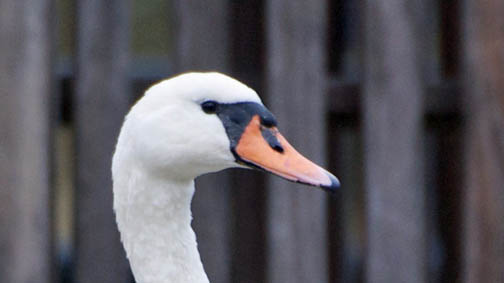
       A cold front moved through the New York area last night bringing gusty winds and rain along with some significantly lower temperatures.  Yesterday at this time, the temperature crept up towards the 60 degree mark.  Today, it is now 45 degrees with a low of 29 forecast for tonight.  Fall is making its presence felt.  We’ll get out into the field tomorrow with bright sunshine on its way.  For now, however, I decided to try a 5 minute blitz upon the birds at our feeders.   I mentioned in yesterday's installment that the birds were mighty hard to come by as I drove down a normally productive area nearby, Mine Road.  I had all I could do to snap a couple of shots of two birds….the American crow and a Mute swan.

       Today, through the window of our sunroom (a definite misnomer for the present weather conditions), I found plenty of birds.  Nothing exotic, but attractive birds nonetheless. 

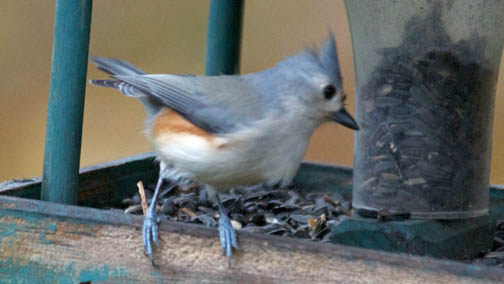
       The shots today are purely documentary in nature as I rarely elect to shoot my subjects while they are perched on a feeder nor is shooting through glass a suggested practice.  I prefer settings a bit more natural than the steel and plastic backgrounds provided at the feeding stations.  But, I just wanted to see how many I would be able to photograph in one 5 minute burst.  And so…here are the results:

The ever present House sparrow….


Another songbird found throughout the year at our feeders, the Tufted titmouse…..

A feeder bird much more obvious during the colder months, the Black-capped chickadee……


Another frequent visitor, the White-breasted nuthatch…..


The “King of the roost”,  the Blue jay…..


Another of our “winter birds”, the White-throated sparrow…..


The American goldfinch in its more drab winter plumage……


and finally, a European starling, this one impaired by the loss of one of its legs…..


       In total, eight species showed up during the five minutes I observed the feeders this morning.  A pretty good number, but in reality, not all that different from what I would normally expect to find here.  The collection of species will vary from season to season, but there is always something to entertain us right outside our windows.

Monday, November 12, 2012

Day 316: November 12th - Shades of gray


Overcast, breezy and temps in the mid 50s

       When I awoke this morning, it was to the forecast on the radio calling for a nice fall day with sunny skies and temperatures reaching 65 degrees.  I dressed accordingly, grabbed my Nikon and headed out to Mine Road for some autumnal birding.  As I hit the door, I realized that this was not the nice fall day I had been promised by WHUD.  Rather, it was gloomy, damp, and cool.  Back into the house for a fleece and then back to the RAV4.  I changed the speed of the ISO on the camera to compensate for the overcast conditions and hoped for the best.

       I stopped at Brooks Lake to check in on any fowl that might be on the water. I was disappointed to find nary a single duck and only three swans.  Two were on the far side of the lake while the third seemed to prefer dry land this morning.  As I photographed the swan, I made note how in this cloudy condition, even the brilliant white plumage of the swan seemed muted (no pun intended). 

         As I headed back to the car, a pair of crows flew by and one landed in a nearby snag.  This bird’s dark silhouette seemed very appropriate for this day as I snapped the image against the gray sky.


       Out on Mine Road, the only thing audible was the rustling of the remaining leaves on the trees.  No sign of any flying birds of any size, shape, or color.  The scene was eerily subdued and the only sign of any color at all was in the golden hue of the grasses lying low to the ground.  


Perhaps it was simply that my senses had become so attuned to the deep emerald tones of the New Zealand countryside that everything back here in the throes of pre-winter fall seem so bland.  Tomorrow, rain is predicted, but the following day, bright sunny skies and brisk temps may bring me back to an appreciation of the true beauty of New York autumnal weather.

Sunday, November 11, 2012

Day 315: November 11th – Back home


A pleasant sunny day with mild SE winds and temps in the low 60s

       We’re back home and jet-lagged to say the least.  Although we managed to get 11 hours of sleep in last night, we can still feel the effects of the marathon traveling we did yesterday.  We decided to take a short trip up to the top of Perkins Memorial on Bear Mountain to say “we’re back” to the hawk watching group. 

       Although we did not see any hawks in our short visit, we did notice how drastically the “look” of the mountain has changed since we were last here some three weeks ago.  In our absence, southeastern New York has journeyed closer to the winter solstice, has experienced a severe hurricane and has been the target of a nor’easter shortly thereafter.  What had been a beautiful richly hued mountainside was now barren of any foliage.  The sun hung low in the autumn sky in spite of the early afternoon hour and the shadows of the of the peak were quick to glide across the lowlands lying to the east.  Having left the rich green mountains of southern New Zealand only a day ago makes the contrast all the more stark.  But this is autumn, one of the reasons we chose to stay here in the Hudson Valley, and we expect to see changes occurring each and every day and the changes are in fact usually gradual.  It is only when you haven’t seen the evolution on a day to day basis but rather after being away for almost a month that the metamorphosis seems so drastic. 

       We’re glad to be home, we’re glad to see that autumn is here and glad to know that the solsice will be soon upon us with all its cold temperatures, white blankets of snow, and early sunsets. 


Day 314: November 10th- Flying home


Sunny and mild, calm skies

       There are long days and there are loooooooooooong days!  Today, by the time we ended up we had flown from Auckland to Sydney and then on to Los Angeles before making the final leg of the trip to New York.  In sum total, we had been up for more than 34 hours from our waking up at 4:00 AM in Auckland until the time we laid our heads down on our pillows in Highland Falls at 1:00 AM.  In the process, we had crossed the equator and the International Date Line.  While in the Southern Island in New Zealand, we did not see the sun set until almost 9:00 PM.  Back here in New York, further from the poles, heading into winter, and having finished with Daylights Savings Time, our skies are dark by 5:00 and the sunsets are coming earlier every day. 

       Just a couple of shots for the day as we spent most of daylight hours in airplanes and airports. 

First, departing New Zealand.....


And later (much later) that day, arriving in New York.


Day 313: November 9th – Departing Queenstown


Another spectacular sunny and warm day

       We’ve spent close to three weeks in Australia and New Zealand and have experienced a sum total of approximately 2 hours of precipitation.  In spite of the fact that we’ve have been in temperate rain forests for a good part of the trip, Meteora, the goddess of weather, has been more than kind.  Sunny days make for good photo-ops and I can’t even begin to describe the superb conditions we’ve had. 

           We’ll fly back to Auckland for our last night of the journey, so I made a quick trip out to the Queenstown Botanical Gardens to check on the avian life and hopefully get a few more photos.  The gardens were beautiful, but it was the waterfront of Queenstown Bay on Lake Wakatipu that provided the most birdlife.

       As I walked down the boardwalk and came onto the beach, I noticed two birds which looked obviously different from any that I had seen here during the past two days.  Through the binoculars, 

I made them out to be Australasian crested grebes, a bird I had marked as a target since reviewing the field guides.  The pair came in fairly close and with the light at my back were in perfect position to be captured by the camera.  Some times things just come together with a minimal amount of effort on the part of the photographer.

       The second bird to pose for me was a small flock of New Zealands only diving duck, the Scaup.  These birds look very similar to our two North American scaups and behave in like fashion as well.  It’s nice when you are in a foreign land and can easily identify a bird by its similarity to those that are already in your mind’s eye.


        Another bird that I already had on our trip list but had failed to capture the “ideal” image  of was the Black-billed gull.  My first views were several days ago in Milford Sound, but they were distant and the images were not satisfactory.  Today, however, the birds were obviously “city birds”, birds used to having humans close by.  I was able to walk up and photograph these diminutive little gulls from a distant of several feet with no problem. 


       Finally, in the gardens, I heard a song that has become quite familiar…a lovely warbling crisp clear song of the Chaffinch.  I’m amazed at how many of these birds are around.  They are as common as our House sparrows, but in my opinion much more handsome.


       Unfortunately, time is running short for our visit to Queenstown and it is time to head back to the hotel and the coach for our ride the tha airport.  From there, it’s on to our departure point from New Zealand, Auckland.  I have made a promise to myself that we will return to this magical place.


Thursday, November 8, 2012

Day 312: November 8th – Skippers Canyon and the Kiwi Wildbird Park


Bright sunshine, temps in the high 60s, calm winds


       Our good fortune with the weather continues as we head out to Skippers Canyon under bright blue skies and warm temperatures.  Several years ago when we visited Costa Rica, we made our way up to the Monteverdi Cloud Forest via a long windy and narrow road (somewhat of an overstatement) where on most of the turns we looked out the window to see a sheer 600 foot drop with no guardrail to prevent our sudden decline should the driver make the smallest of driving errors.  Well, today, we revisted the same scenario, only this time we are in the Southern Island of New Zealand.  In Costa Rica, we traveled in full size coaches, but here the roads are too narrow to accommodate such vehicles, so our group has been split up into two mini-vans.  This is s photo of the view looking out the side window of the van as we rounded one of the corners.


       We eventually made it down to the floor of the canyon and prepared for our journey up the rapids via jet boat.  The boat draws no more than 2 inches of water and in certain areas, the cushion of water flowing over the boulder strewn bed of the river was not much more than that in depth.  Check out the following video clip to get a feel for what the experience was like!


       Following the trip on the rapids, we ascended the canyon walls to a flat area where we embarked on a helicopter to take us over the Remarkable Mountains to Bob’s Peak. 


       Once on top of Bob’s Peak, we came back down into the town of  Te Anau by way of the cable tram and visited the Kiwi and Birdlife Park at the foot of the tram.  I’ve mentioned before that zoos and wildlife parks are great places to see wild birds that are attracted to the birds in the cages and on display in open enclosures.  We did get to see the rare and elusive Kiwi in a special enclosure in which they simulate the night for folks visiting in the daytime.  It was great to see this rarity even if it was a captive bird.

               My prized catch of the day was the up close and natural view of the Paradise shelduck seen above.  I’ve been frustrated by seeing these beautiful ducks from a distance but had failed to get close enough to get a nice photo.  Well, today I had one almost walk across my feet as it scampered by calling out and looking for its mate and their young.  Unlike most birds, it’s the female that is the most attractive in this species.  Eventually, she did find the rest of the family and they hung around for a while, bathing in the open pond on the land and feeding along the shore.  It’s becoming more and more obvious that I really have to return to New Zealand and spend time concentrating on the birds.  With one day to go, I’ve photographed more than 35 new species not counting the considerable number I got in Australia.  Not bad for a tour of the country not really concerned with the avian life.  Times drawing short, however, and I would really love to grab a few more shots tomorrow.  We’ll see…..


Wednesday, November 7, 2012

Day 311: November 7th – North to Queenstown


Sunny, cool, and calm

              It’s simply incredible that one beautiful day follows another throughout the majority of our journey through Australia and New Zealand.  In a land where rain is the rule and sun the exception, we’ve been blessed with bright sunny skies an inordinate amount of time.  Much of today will be spent travelling in the coach, so Sharon and I got up early and took a look around Lake TeAnau, hoping for a new avian species.  While not new, the Tui was kind enough to come down to a tree right near us and serenade us with the sweet melodic song that Tui’s sing.


         The Chaffinches and more Scaup showed up, but these are becoming so common as to raise little ambition on my part to photograph the unless in perfect light.  Both of these species were unfortunately in the shadows and although I did spend some time trying to wait them out, the end product was far from “blog worthy”.  A similar situation arose a few Black-billed gulls flew into the shadows of the early slightly overcast morning.  Finally, a Welcome swallow landed on a piling nearby and since these are not so easy to get decent shots of,  I did my best to capture images which were good enough to use in identification.  Man,  I wish more of these little guys would be willing to come in a bit closer to make the images published in the blog all “museum quality”.

       Soon, we were on the road again, this time heading for Queenstown, three hours north of our overnight digs in Te Anau.  Along the way, we got a good idea of how this verdant land is used for grazing lambs, cattle, deer, and even a non-native deer from Europe known as the Wapiti.   For a while in the past decades, these deer had established a wild population and were becoming feral.  A massive program to recapture the wapiti and begin to establish wapiti farms  has begun to thrive.

       The default farm, however, was naturally the sheep farms where the sheep are raised for wool production and the lamb exported throughout the world as a meat product.  


       Birding was tough as we sped by the fields at 80 to 100 KPH.  Many a Australasian harrier was spotted only to fly on by without so much as a misfire from the Nikon.  Other smaller black and white birds  not only eluded the camera, but were so fleeting as to keep us from getting a good enough look to firm up an id on the birds.  Later, at a rest stop, however, we were able to carefully study these birds and get some fuzzy distant pix.  We found that these were an introduced species known as the “Spur-winged plover” and talking to our Kiwi coach driver also found out that there is not much love for these intruders.  If the locals are out hunting ducks and spur-wing happens by….well, there will be one less plover.

       We finally arrived at the town of Queenstown and toured the waterfront where we made note of several species which we will pursue with the camera tomorrow morning.  It’s a lovely town and really has a nice laid-back feeling to it.  Can’t wait to explore it further tomorrow.


Tuesday, November 6, 2012

Day 310: November 6th – The Fiordlands


AM low 40s, sunny, warming to the 60s

       A chilly departure from our hotel in Te Anau as we head to the Fiordlands National Park and Milford Sound.  This area receives more than 21 feet of rainfall per year and is at a latitude which generally means chilly temperatures.  So, we dress accordingly and prepare to be ready for whatever Mother Nature doles out.

       Much to our delight, the sun is shining brightly and the winds have abated.  Our journey down to the sound is nothing short of spectacular.  Bright azure skies, calm winds, and temperatures which rapidly rise up into the 60s make for a picture perfect day in early November as we head to the fiords.  The road to Milford Sound winds through the countryside between towering alpine peaks and along broad glacial flood plains.  Harriers, oystercatchers, Paradise ducks, Chaffinches, and Tuis escort us through the valleys and up into the mountains.  At one stop, we come across New Zealand scaup swimming in a slow moving glacial stream adjacent to the road.

        We continue along the valley floor before ascending the alpine highway where we make frequent stops to photograph the horns, arêtes, and cirques of the mountain glaciers.  Landslides and avalanches are common sights along this serpentine roadway and make for a constantly changing landscape.

       Our driver Ian mentions that we should find the only alpine parrots found in the entire world, the Kea.  The mischievous bird is known for landing on parked cars and making quick work of the rubber gaskets around windshields.  They will steal anything that is not secured to the vehicle and basically have no fear of humans  That certainly makes photographing these parrots quite easy providing you can keep them off your equipment.

       We desend  down the mountain divide through a lengthy tunnel hewn through solid rock by human hands wielding picks and sledges.  We travel the long winding trail to Milford Sound and then cruise through the fiords all the way to the Tasman sea.  We encounter a pod of young sea lions basking along the walls of the sound,


 and sight a little  penguin scampering up the hillside as our boat approached,


       Returning back to Te Anau, we make a quick trip over to the wildlife preserve where the previously thought to be extinct Takahe can be found, albeit in a cage on display.  I normally  don’t even bother to photograph captive birds, but seeing as how there are as few as 120 wild birds in existence today, I figured I’d better capture the image of this bird while I could, regardless of the circumstances.

       Tomorrow, we begin our trek north once again and will be in Queentown for the next two days before we begin our journey back to the homeland.  As long as the trp has been, it seems as though we’ve just begun.  Where does the time go?  And yet, as enjoyable as this three weeks has been, it is finally time to start thinking about friends and family back home.  Still, we have a couple of more days to continue our visit of the land down under.  Let’s make the most of it!


Day 309: November 5th- Marlborough Sound


A crisp cool clear day

       It’s a great day to be out on the water today as the winds out of the cool south have continued to blow the foul weather out of the area and have brought a crisp clear day to the southern island.   We’ll begin the day with a cruise out of Havelock onto the Pelorus Sound to see an active mussel farm and enjoy the gorgeous scenery along the way.

       On our way out to the farming waters, we passed a number of shore birds working the shallows of the sound.  Several new birds including several new shags were found and properly identifying them proved to be a chore.  Nonetheless, we are pretty sure that we have it correct now and came up with the following species.

       The Pied shag was one of the easier birds to identify with its bright yellow lores being distinctive.  The bird also tends to be a loner which this bird was.   These birds are generally found along the coasts of the North Island, but they do occasionally venture to the Marlborough sounds of the South Island.

       Similar in appearance but lacking the yellow markings of the face, the Little shag has a shorter bill.  Although preferring fresh water, they do show up in shallow marine environs.

     We also had Spotted shags which were too distant to record decent images.  Likewise, other waders were found far out and could be identified with the bins but were hard to capture with the camera.  Still, we did manage to get a good enough shot of the Variable oystercatcher as it took off from the shoreline and flew out towards the boat.  The Variable version of the bird is much less common than the South Island Pied form but was identidied by its total black plumage.


       We finally arrived at the mussel beds and learned how these pristine waters are so conducive to the growing of this tasty shellfish.  The green mussels grown here are shipped after being processed to North America, Europe,  and Australia as well as being a main staple in local restaurants. 

        On the return trip under  sunny skies, we spotted several more additions to the New Zealand list.  Among these was the very common White-faced heron.  This bird is the most common of all herons in New Zealand.  It seems that as common as they are, they are slqays just out of cameral range.  This one was at least close enough to give us an image suitable for identification purposes and we’ll take what we get.

       Tomorrow, it’s off to the Southern Alps and the Fiordlands National Park.  Can’t wait for the stunning topography and associated wildlife.  The area generally gets over 200 days of rain each year, so let’s all pray for good weather to visit this most spectacular place.


Sunday, November 4, 2012

Day 308: November 8th – Wellington, NZ


A sunny but cool day with brisk morning winds


       After yesterday’s and last night’s rains, we didn’t quite know what to expect this morning, but Mother Nature took good care of us once again and blessed us with sunny skies.  The winds were out of the south.  Now back home, that means warming conditions, but here, south means Antarctica.  And so the winds were chilly, brining the temps down into the 40s but also blowing the bad weather away.

 
       Our first order of business today was a quick bus tour around the city of Wellington.  We made our way up to the highest point in the area and had wonderful views of the city and its harbour.  What’s more, we had excellent views of a new life bird called a Tui.  Tui’s are the largest of a group of New Zealand birds known as the honeyeaters and indeed, this bird was captured by the camera while taking advantage of nectar bearing flowers up here at the summit of this mountain.
                           
      We then travelled to the Botanical Gardens to see the Rose Gardens which were close to being in full bloom.  The flowers were spectacular and the birding was not all bad either.  Still, this is an urban setting and therefore the most common urban bird just about everywhere in this world is the House sparrow.  We did get the common blackbirds which seem to be everywhere we visit lately as well, a close-up photo-op of the Song thrush,


       and a second shot at the beautiful Chaffinch in a true garden setting.
 
     
        An afternoon stroll around the wharf failed to turn up anything  new, so that will have to wait until we visit the South Island and Blenheim and the Milford Sound over the next two days.

Day 307: November 3rd – Rotorua


Cloudy with periods of showers, high 50s

       A day of travelling south along the North Island of New Zealand.  Eventually, we’ll fly the second southern half of the island, but first a couple of stops along the way.  Our first destination is Longland’s Farm, a dairy farm where we’ll learn about “green” farming of dairy cattle. 


       The climate is so wet and so mild here that grass grows 365 days a year.  Each farm is divided into a number of paddocks where the cattle will graze for one day before moving onto the next the following day.  In this way, each of the 20 or so paddocks has a chance to regrow its grass for the next 19 days before the cattle return to graze on that same plot.  The farmer therefore needs to spend a minimal amount of overhead on silage.  The green fields also are a benefit to the avian life.  I could see quite a bit of activity out in the fields, albeit distant, and managed to get one quick shot during out short stay of one of the Goldfinches.

       As we continued our journey south to the geothermal grounds of Rotorua, the rains began to fall…..first gently, but then more in earnest as we approached the actual site.  About half of us decided to walk the grounds in spite of the downpours and while the birds refused to come out from under cover of the surrounding forests, we did get some nice wet views of the geothermal features.

       We departed and made our way to the local airport for a charter fight down to Wellington, capital city of New Zealand.  Tomorrow, we’ll have a chance to visit this city and look for still more southern hemisphere urban birds.  Til then…..


Friday, November 2, 2012

Day 306: November 2nd-Waiheke Island


Mix of sun and clouds, calm winds, mid 60s

       We take the ferry across to Waiheke Island, the second largest of the islands along the east coast of New Zealand.  With a total population of 6000 full-time residents, it is surprising vibrant with several wineries, a small family run Olive oil producer which has produced olive oil this year ranked as being one of the top 20 in the world, a golf course, and a beautiful beach.  We visited the oil producer and the Mudbrick Winery today, and the beautiful grounds upon which these concerns lie afforded me the opportunity to perhaps find a few new birds!

Leaving Auckland 
       Along the coastline, we found more of the traditional Silver gulls (also known as Red-billed gulls here), too many House sparrows to count, numerous mynas, and some Blackbirds.  The first new bird to the list was located at the Olive oil producing press.  We both spotted a gorgeous Eastern rosella which preferred to remain high in the canopy out of reach of the lens of my camera.

       As we moved on to the winery, however, I did manage to capture a couple of images of several new birds added to our New Zealand list.  The first was a strange looking bird resembling the Moorhens and gallinules we’ve seen before.  This bird is called a Pukeko, the main difference between it and its aforementioned cousins being its extra heavy bill.  As it turned out, we did find several in different locations around the winery.

       We had a bird we had previously seen in Ireland next.  The bird is a Chaffinch, and it was just as handsome as we had remembered from our previous sightings.  This one helped us out by perching on the posts used to support the wires upon which the vines grow fairly close and in good lighting.


       Finally, goldfinches.  Not the American goldfinches of North America, but New Zealands own brand with just a bit more panache, a bit more flair.  With brilliant red faces, and a spash of bright yellow down the wings, this bird was even more beautiful than our pretty ones back home, but actually flew in much the same way and had a song reminiscent of the North American variety.


       Our last bird of the day was a Black-backed gull, also called a Dominican gull.  Like our Greater Black-back, this is the largest of the gulls found here in New Zealand. 


       Tomorrow, it’s off to the land of the geysers and thermal springs of Rotorua.  Can’t wait to see what special species these lands bring to us.  C’mon along!

Thursday, November 1, 2012

Day 305: November 1st – Flight into Auckland


A cool, sunny day

       The day is pretty much totally consumed with getting over to the airport in Sydney and flying over to Auckland, New Zealand.  I did manage to get out to the local park across the street and found a gorgeous Rainbow lorikeet high in the canopy….too high to get me a shot, however.

       My only other birds in the 15 minute walk around the park before we needed to board the bus for the airport were the expected Common myna and the nesting Australian white ibises.

       Once we were in the air, I grabbed a few shots of our home for the past 11 days, Australia.  We were fortunate to have great weather for our entire tour of this magnificent country, but now we look forward to be introduced to yet another magical land, New Zealand.


       As we approach the land of the kiwis, the stark difference in the two countries is immediately apparent.  This land is rich and green, unlike the dry desolation of much of Australia.  The city of Auckland is also much smaller and nowhere near as busy as Sydney or Melbourne.  It will be quite a change to get into the green wet lands of New Zealand as we head out to the countryside tomorrow morning.  Looking forward to new lands and new birds!