Thursday, September 13, 2012

Day 257: September 13th – Birding Brigantine


Sunny, mid 70s with a light breeze

      We arrived down in Jersey around 12:00 PM and headed straight out to Brigantine unit of Forsythe National Wildlife Refuge.  The tide was perfect as the mudflats were exposed.  Even in the middle of the day, if the shorebirds are around, they should be here. 
Mute swans and tree swallows

        As we entered the refuge, we were amazed at the number of swallows. Hundreds, more likely thousands, of tree swallows were everywhere we looked.  A constant flow of the birds were in the process of migrating down the coast and were taking advantage of the small insects associated with the wetlands.  Fortunately for us, the green headed flies have all but disappeared by this time of year.  Unfortunately, the mosquitoes have attempted to take their place.  Even these have not become a major distraction, however, so we had great weather and great conditions all around for our 8 mile drive around the refuge.

        What a beautiful sight to see the expanse of wetland vegetation punctuated by the pure white plumage of the Great egrets and Snowies. 


       What we did not find an abundance of were the shorebirds and waders we were hoping to see.  Greater and Lesser yellowlegs were sporadically found usually hanging out in small groups of a half dozen or less. 

       We have seen immature Black-crowned Night herons and their parents each time we have visited the refuge over the past couple of months.  Today was no different save that the juveniles seem to be a bit more brazen…..standing out in the warmth of the mid-day sun while their ever attentive parents perched back in the cover of the vegetation.  It will take about 3 years for the young Black-Crowns to reach full maturity. A juvenile like this one has yellow-orange eyes, yellow-green legs and a dark brown plumage with cream colored spots and streaks. His belly is streaked brown and white.. The second year bird has more of a plumage like the adult; it will be browner with a dark cap and back and brown wings and neck.

       We had mammals as well as birds out on the refuge today.  Three white-tailed deer were out in the middle of the main impoundment grazing on the vegetation.


       There were also large numbers of red-winged black birds, but for the most part they were females.  The females look nothing like the males and at first look appear more like sparrows on steroids than their male counterparts.


       By days end, we had just shy of 40 species, but were surprised that we came across few of the migrating shorebirds we had expected.  It has been a warmer than normal summer and perhaps the insects and seeds are abundant enough to keep some of the migrants in the breeding grounds a bit longer than usual.  We’ll continue to monitor the movement of the birds as autumn approaches and the days become shorter.

Wednesday, September 12, 2012

Day 256: September 12th – Down at the farm(s)


High 70s, dry and sunny

       Another spectacular day to be out and about.  We had to be up in the Fishkill area today due to car problems.  So we headed up to Vassar Environmental Farm in the hopes of some migrants.  On the way, we decided to make a quick stop at Stonykill Environmental Farms to check on the fields and woodlands of that wonderful spot.  On the drive in, we encountered a number of Eastern phoebes which suddenly appear to be everywhere.  I think most are young ones as they have little fear of us approaching in the car or on foot.  We had a good number of them yesterday at Minnewaska and here again today. 

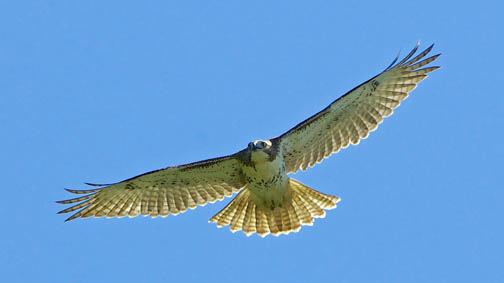
       Around the main building, near the parking lot, we spotted a Red-eyed vireo and met up with some birding buds who had already found Blackburnian, Bay-breasted, and several other warbler species.  After spending a short amount of time checking on these birds, we moved back down towards the barns.  Here we found a nice young Red-tailed hawk perched above the fields.  I managed to get quite a few photos until a large group of European starlings decided to move the hawk out of “their” territory.  As the hawk took flight, a second joined him and both flew off together.


        On to our eventual destination, Vassar Farms up in Poughkeepsie.  The site is home to a community garden with a variety of vegetables and flowers growing in fenced in plots.  We often find sparrow of various kinds here, but today, the only sparrow in sight was the all-to-familiar House sparrow.  We can also count on American goldfinches, and they did not let us down.  One of my best subjects was a young one bathing in a puddle.  Again, the bird cared little about my presence and actually landed in the water not more than 10 feet from me and started to bathe.  He really looked as if he was enjoying the experience. 

        I also had a nice view of a Ruby-throated hummingbird which was trying desperately to  get to a beautiful patch of gladiolas.  He was on the wrong side of a mesh fence and could not get to the flowers.  All he had to do was go up and over the fencing material and the prize was his.  But, I never did see him take that course, and eventually he flew off in the opposite direction  in a fit of frustration.

       I then heard the high pitched cries of yet another Red-tail.  I looked up and saw the hawk approaching me.  I ripped off a few shots as he flew past soon to be followed by a kestrel flying at right angles to his path. 

       Tomorrow, we will head back down south to Jersey and perhaps Delaware if time permits for another short trip for shorebirds and whatever else we might run into.  

Tuesday, September 11, 2012

Day 255: September 11th- Minnewaska State Park


A sunny, cool, breezy day

          It was a cool, brisk morning as we met at Minnewaske State Park outside Gardiner, NY for a day of searching for fall migrants.  The weather for the day was picture perfect, reminding us of this day 11 years ago when the unthinkable happened in New York City.  While we had a fine day of hiking and birding, our thoughts often returned to that awful day..
Flycatcher

       We found 12 species of warblers, many in their “confusing fall plumage” and it was a challenge which required the input of many of the 16 folks attending today to finalize an identification on many of the birds.  The birds remained aloof, hiding deep in the shadows of the foliage and uttering barely a chip-note.  Granted the Black-throated blues, the Common yellowthroats, and the Hooded warblers gave us a better clue by occasionally singing a short refrain, but for the most part, it was pretty silent.  We relied on watching for their movement to give us a hint as to where the birds were.

       As I mentioned yesterday, the hawks are beginning to move south and it was a pleasure to see the Broad-wings heading south.  We often see large kettles of more than a hundred birds at this time of year, but today, the largest kettle of the hawks was three birds.  Most of the other sightings involved solitary raptors.  A sharp-shinned hawk and a Red-tail were the only other species to show up, but watching the hawks soar on high was as “uplifting” for us as it was for them.

Broad-winged hawk

       The other main bird of the day were the ravens.  Ravens love high altitude habitats and the more than 21.000 acres of Minnewaska rise to more than 2000 feet above sea level.  At one point, several ravens and a Northern harrier were flying in close proximity to one another and it was interesting to note the drastic difference in size between the two birds with the harrier being almost a half a foot smaller.


       After four miles of hiking over a period of almost 6 hours, we had tallied 41 species.  Unfortunately, few photo-ops arose as the birds remained in subdued light.  Nonetheless, it was a wonderful day to be out, and yet a somber day to reflect on the past.

Monday, September 10, 2012

Day 254: September 10 – Bear Mt. Hawk Watch


Sunny and cool (low 70s) with a light NW breeze

       Each year for the past decade or more, a loyal group of dedicated birders ascend to the top of Bear Mountain to take part in the annual hawk watch.  This is not a one day  affair.  In fact, it is a daily venture beginning on Labor Day weekend and continuing all the way through Thanksgiving.   Our leader Joe S. has been at the helm for many years now and continues to be the mainstay of the project. 


       We are following and documenting the fall migration of hawks, vultures, ospreys, falcons and eagles as they move south down past the Hudson Highlands.  We keep tallies of what species are seen and how many of each pass us each day.  Each member of the group will show up whenever he or she can to assist with the count.  At times, there may be 15 or more folks taking part, and at other times, it’s just Joe.  Spotting scopes, binoculars, cameras and computers all are valuable tools.  When the year’s count comes to an end, the data will be sent to Cornell University’s Lab of Ornithology where it will be added to the counts done by other volunteer groups across the eastern seaboard.

       Each week brings a new group of migrants through the valley.  Right now, we are on the leading edge, so it is primarily Bald eagles, Red-tailed hawks, and an occasional hawk of other species that wanders on through.  Soon, however, the first wave of massive migratory movement begins with the Broad-shouldered hawks making an appearance.  We are about a week and a half away from the expected “flood” of these birds.  One they about Mother Nature…..you can never say “always”.  There are trends, and these are when the birds are expected.  But they don’t always read the books, and they may show up earlier or later than expected, or they could take a different route this year and not show up at all!  But this is why we are there. When all is said and done, the powers that be will have a better idea of where and when the raptors migrated this year.  We’ll just have to wait and see how it plays out.
Red-tailed hawk

      After our day’s watch today, we had only several birds….two Bald eagles, two Red-tailed hawks, one Osprey, and a Northern harrier which flew south past our vantage point. 

Northern harrier

       As we headed back down off the mountain, we ran across several white-tailed deer who approached our vehicles as if conducting their own inventory of how many humans passed through their territory. 


       We’ll be back later this week to help out once again and hopefully begin to see more and more of the travelling birds heading south. 

Sunday, September 9, 2012

Day 253: September 9 – Kenridge day 2


Sunny, mild in the mid 70s, calm

       A perfect day following our storms of yesterday.  As I mentioned in yesterday’s entry, Sharon and I revisited Kenridge Farm today for a follow-up day of birding.  Once again, our favorite bird of the day was the Merlin which was still on site. As he did yesterday, he made several low high-speed passes as we watched with awe.  What a spectacular bird.  Once again, he was faster than I was and I did not get a shot.  I will return this week with that one goal in mind, however.  Hopefully the bird will still be around.

        In addition to a good many species we found yesterday, today’s best shots go to two common dwellers in the fields of New York.  The first is the Black and yellow garden spider.   A good sized spider, this individual did not look exactly like the garden spiders I have found in the past, and so, this photo and id is subject to review.  If and when I find out a positive id which differs from the one I offer here, I will update this entry and set the record straight.  For now, it’s a Garden spider whether it wants to be one or not.

Dorsal view
Ventral view

       The next photo of interest is of the Praying mantis.  A master of camouflage, the green coloration of this insect allowed it to blend in so well that I had to examine the spot where I first saw it carefully to make sure it was still there.  It’s ability to hide in among the foliage of the vegetation allows it to lie in ambush, waiting for some unsuspecting insect to wander in too close before it is too late.  If necessary, the mantis will pursue its quarry, but it prefers to simply grab a bite as it walks by.  Fascinating insect!


Saturday, September 8, 2012

Day 252: September 8 – Merlin at Kenridge


Overcast with the threat of rain, mid 70s

       We’ve resumed out regular fall schedule of field trips for the Mearns Bird Club in Orange County, NY and it’s my turn to lead.  I selected the Outdoor Discovery Center of the Nature Museum of the Hudson Highlands as our site today. Fondly known by it’s former name, “Kenridge Farm”, it has always been a mainstay for those wishing to find birds in any season.  Our club conducted a year-long census this past 12 months to establish an inventory of what birds we can expect to find and when.


       For the year long period from June of 2011 until May of 2012, we recorded no merlins on site.  One of the fastest of the falcons, the merlin is also one of the smaller.  In spite of its size, however, it is more generally more full-bodied that many of its counterparts.  Its buff to orange breast is often heavily streaked and it lacks the “side-burns” or “mustache” found on other falcons.  Its prey of choice is small or medium-sized birds which it often snatches from the air in mid-flight.  I often flies close to the ground, using trees and shrubs to cover its approach until it is upon its prey.

Merlin I photographed at Cape Canaveral 2011

Merlin image I shot in 2010
       We were blessed today to have extended looks at a merlin which spent much of the morning chasing Blue jays.  We would watch it perched high in the snags on the opposite side of the field we were birding.  The jays would all be congregated in nearby trees watching the merlin until it took flight and would fly into the group causing them all to scatter. (Unfortunately, the camera and lens I normally carry into the field on extended walks like this mornings is in the shop for repairs, so with your indulgences, I am using several archival shots of merlins I took in the past.)

     The more we watched, the more we began to surmise that the merlin was not all that interested in making a kill this morning, but rather he appeared to be playing, chasing the jays and making no real attempt to hit any of them.  Occasionally, he would take off from his high perch, soar down to ground level and cruise across the fields at lightning speed.  Its been said that if you see a bird of prey and its by you before you can say its name, it’s a merlin.

       Although the merlin was by far the highlight of the day, we also had 40 other species on our walk.  The warblers were hard to find as they apparently have not yet begun to move through our area in earnest.  Strong storms coming out of the northwest are forecast for later today and tonight, and it is just possible that we may find some of this fine songsters right here tomorrow when Sharon and I return to lead another walk for the museum.  For today, it was a magical show put on by Mr. Merlin.  What a pleasure to be able to share it with 20 of our fellow birders.


Friday, September 7, 2012

Day 251: September 7 – 7 Lakes Drive


Sunny, warm, and calm

       Great day for a ride along 7 Lakes Drive, a scenic parkway 18 miles in length in Harriman State Park.  In its hay-day, each of the lakes was a recreation area with swimming, boating, and fishing throughout the summer and skating, ice-fishing, and cross-country skiing during the winter months.  The economic woes of New York State have led to the closing of some of the beaches and curtailment of other recreational activities at some of the other lakes.  Nonetheless, it retains its beauty and in spite of the fact that none of the 7 lakes on 7 Lakes Drive are natural, it is a beautiful place to “get into nature”, even if just from behind the wheel of a car.

Lake Welch 
       Now that summer has past, the drive is quiet during the week.  As the fall wears on, the place becomes even more secluded and its possible to drive the entire 18 miles without ever seeing another vehicle.  Pulling off the side of the road or into one of the parking lots which remain open after Labor Day, you can find a lot of Mother Nature’s best right along the roadside.  With only a short time to take out of our busy day today, we took the route on our return from New Jersey and easily found several locations for our blog shots.  First encountered was Lake Welch, a place near and dear to me as I spent several summers working as a life guard here back in my college days.

       Along the roadside, we found a great many wildflowers including this pretty pink Lady’s thumb smartweed. 

       While waterfowl and other birds were not abundant today as they are in the spring, we did come across a stately Great blue heron which took flight as we drove by.  Just past the heron, in a field adjacent to Lake Tiorati, we found three white-tailed deer.   Although aware of our presence, they seem to know that hunting within Harriman State Park is not permitted and they paid us little heed.

       As I walked back from the field where I photographed the deer, I nearly stepped upon this fungus.  If you take the time to really look down at the ground as you walk through the forest, you’ll find a multitude of these beautiful organisms growing on trees, on decaying logs, or just along the ground as this one was.

       As the season wears on, we’ll revisit 7 Lakes Drive and enjoy the gorgeous colors of the changing leaves.  It is truly a treasure only minutes from our doorstep.  

Thursday, September 6, 2012

Day 250: September 6th – The Muskrat Pond


Sunny, humid, mid 80s and calm

       I spent a little over an hour at a small pond on the back side of the Discover Center property of the Hudson Highlands Nature Museum in Cornwall, NY.  There is plenty of land to explore at this intriguing site, but without question, one of the most productive corners is back here at the “Muskrat Pond”. 


       Along the short 1/3 mile hike to the pond itself,  you pass through meadows and then forested land.  Along the way, numerous Gray catbirds, Tufted titmice, Carolina wrens, Robins, and a plethora of American goldfinches escorted me.  Once at the pond, I watched a Great blue heron on the opposite side of the water checking out the pond’s edge for any tidbit for an afternoon snack. 

       As I watched the heron, there was a blur from the lone island in the pond as a Eastern phoebe flew out from a snag, hit the water’s surface and returned to his perch….presumably with a protein snack of his own in the form some ill-fated insect.


       I watched the aerobatics of a pair of Blue dashers, male and female, as they hovered above the surface of the water.  The male was covering a lot more area as he protected the pair’s hunting territory.  The female, however, remained in the same air space inches above the water, so motionless save for the wing beats that I was able to manually focus on her for a pretty sharp image.


       There were plenty of other dragonflies to watch and attempt to identify, and a pair of Carolina wrens entertained me by calling back and forth from one side of the pond to the other.  Soon, it was time to head back home, however, to I started the hike back.  Motion in the canopy caught my attention and I found a female Rose-breasted grosbeak quietly observing my trek back to the parking area. 

       I’ll be leading a Mearns Bird Club trip here again on Saturday morning and then a birding outing for the folks at the museum on Sunday, so I will have a pretty good idea of what is on the property in early September by Monday.  So far, so good.

Wednesday, September 5, 2012

Day 249: September 5th – Groundhog Day


Sunny aftermath of a rainy morning, still quite warm

       With automobile registration problems of my own making, we had to delay the start of the birding until late in the afternoon.  Since we were in Haverstraw at the DMV office (delightful as ever), we decided to bird the Hudson waterfront and see if we could find any shorebirds, waders, or fowl.  At the first stop, we had about 40 ducks, but they were all mallards…..each and every one.  There fine looking birds, but you become jaded when you see them almost every day.  So we moved on.

       The next stop was the Haverstraw Bay County Park.  I had an osprey, but he was too distant to afford a decent shot, so I just checked him out and moved on.  Next bird was a nice Northern flicker, but he also was pretty far away and the shots I got were pretty grainy…not worthy of posting.  All of a sudden, however, a big ole groundhog came scampering across the grass and started to graze close to the flicker.  I was in the car, but managed to shoot through the window and over Sharon’s head.  Well, at least we had something to start with.


       On the way out of the park, we encountered two more groundhogs, but these were quick to head into the brush as the car came near.

       We headed just down the road to the marina and tried our luck there.  More mallards and little else.  Little else except for another groundhog…this time a little youngster.  He held his ground in the shadows of a maple, and was close enough to pose for the camera.  That made four of the varmints in about a 5 minute period.

   
        As it was getting close to dark, we decided to make a quick run up to Iona Island and see if we could just possibly find a heron or egret or even a rail!  Not to be, but we did have another groundhog.  And so, while not the greatest birding experience I’ve had this year, it was fun to see so many of the groundhogs aka woodchucks, our largest member of the squirrel family.  Maybe there will be birds tomorrow!


Tuesday, September 4, 2012

Day 248: Feast or Famine in New England


Overcast with periods of rain, mid 70s

       We headed back home today after several days in Vermont with friends.  We’ve had so much fine weather over the past several weeks that it was hard to reconcile having to travel in rain, fog, and cloudy conditions.  We managed, however, and enjoyed the ride and the beautiful New England scenery all the same. 

       As we travelled down through the Green Mountains of Vermont and into the Taconics in Massachusetts, we kept our eyes open for deer and turkeys in the many mountain farm fields we were passing.  Sure enough, in a pasture near the border of the two states, we found a number of turkeys not too distant from the road.  Traffic being what it was (basically non-existent), I was able to stop right in the middle of Route 8A near Ho Cook State Forest and photograph the fleeing birds. 

       The deer were a bit more elusive, however, and we failed to locate any herds on our trip.  As we came into Massachusetts down Route 2 (aka Mohawk Trail) we passed by some marvelous vistas that even with the foggy conditions were breathtaking. 


       Also of interest was the state of the rivers and streams in the region.  A few days ago, I pointed out what a difference a year makes, noting the condition of this area of New England in late August of 2011 and now.  Here is an image taken from the web of the Deerfield River last year with floodwaters resulting from the visit of Irene.

Damage from Irene, August 2011, Web archives

       Cold River, not too distant from this area had quite a different look to it today as we drove along the southern shore.  I’ve been going on and on at the beginning of each day’s blog about how sunny and warm each day has been.  That makes for nice traveling, but it does not make for the best of environmental conditions.  Here is what Cold River looks like today.  It just seems as if it has been a case of feast or famine in New England for the past year.

       It is still mind-boggling what damage Storm Irene brought to the northeast.  We will hopefully not see another storm of such magnitude for some time to come.

Monday, September 3, 2012

Day 247: August 3rd – A Walk around the neighborhood


Another day in paradise – High 70s

       We are still here in beautiful Vermont visiting our friends in Wilmington.   After a blistering round of golf (blisters on our feet, on our hands, etc from soooooo many swings!), we returned to the condo and then out for a walk in the woods surrounding the complex.  A few Black-throated green warblers continue to move through, but they remain high in the canopy and are difficult to photograph.

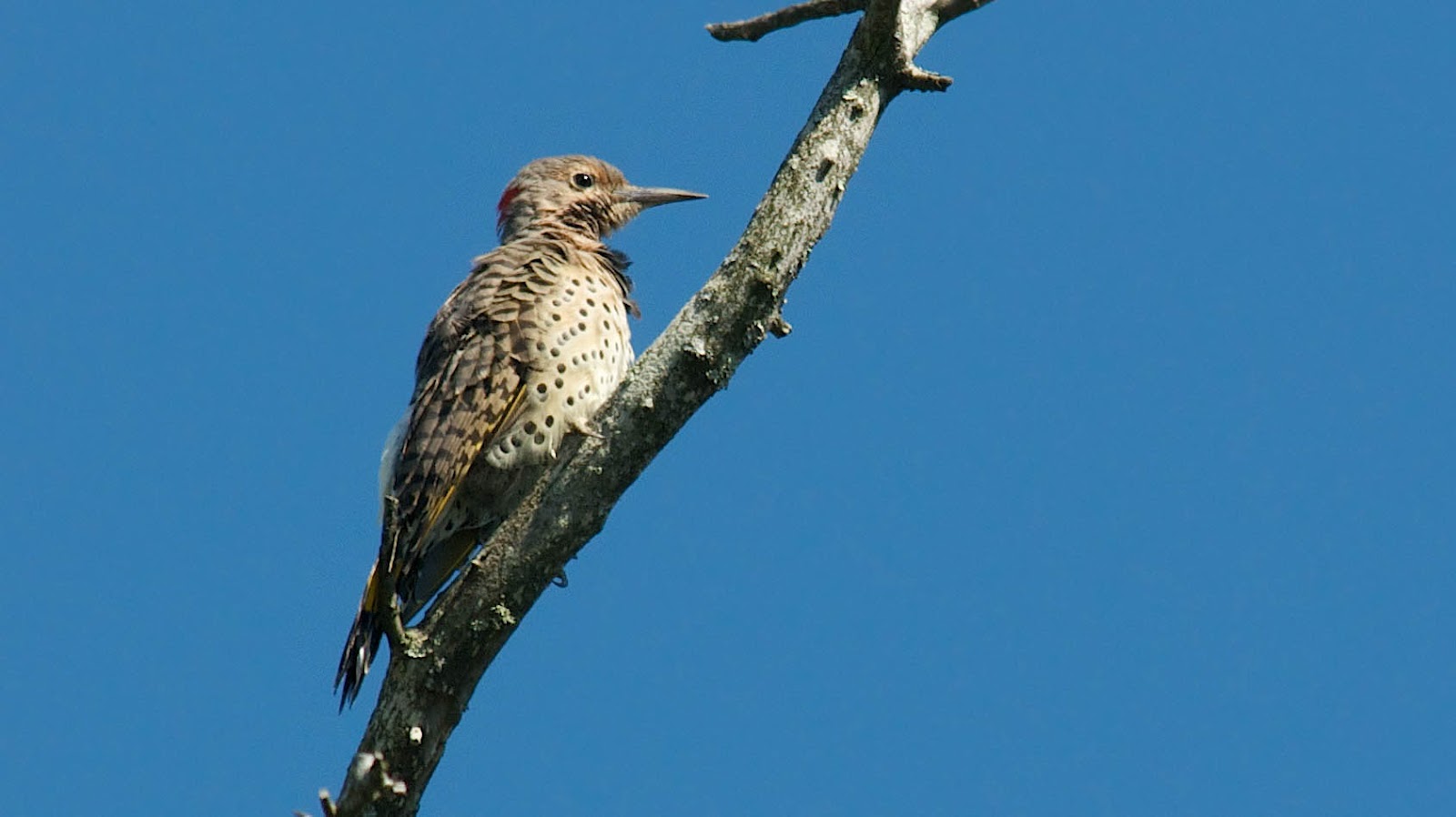
       I did find some more of our “youngsters” today though in the form of a juvenile robin and a juvenile Yellow-shafted Northern flicker.  Both have spotted breasts and have yet to molt into the colors of their species.  The birds have grown to adult size by now, but have yet to get that adult set of feathers.


       Butterflies abound at this time of year with the vast majority seemingly Monarchs.  Today, there are also some Great spangled fritillaries mixed in with the crowd.  The newly blossomed Goldenrod seems to be the flower of choice for all these species today.

        As I came back onto the front porch of the condo, I was greeted by two species of green grasshoppers.  Late August and early September are always great for observing these insects and many of the birds are also quite pleased to see these tender morsels.  Unfortunately for the birds but just as fortunate for the insects, their color helps the grasshoppers avoid predation.  The green varieties hang out in vegetation of the same hue while the brown ones like the Carolina locust we featured last week “know” enough to make sandy soil and beaches their main digs. 

 
       Tomorrow, we will head back to the Empire State.  Still have no plans as to where we will stop over for the “shot-of-the-day”, but there will be something new to be sure.

Sunday, September 2, 2012

Day 246: September 2nd – Vermont


Partly sunny, high 70s, light breeze

       Wandered about the grounds of our friends Vermont condo this morning in search of any warblers or others which might be moving through the area.  I caught sight of movement in the canopy of the trees across the street and quickly shot off a couple of images before I knew in fact what I was capturing.

       Once I enlarged the image and looked carefully, I determined that what I had was a Black-throated green warbler.  Later, I found the same warbler back behind the unit and had difficulty capturing another shot.  I did get great looks around dusk, however, which confirmed my earlier identification.


       Apparently, my view of the warbler was not the only individual to spot this bird.  As I watched this morning, a larger and more ominous view came into my space as a juvenile Cooper’s hawk soared over the area.  Suddenly, the warbler I was attempting to photograph was  no longer seen……smart bird!


       Later, the warbler reappeared, but as it displayed in the bright sunlight at the top of the pines behind Jon and Rose’s back deck, I failed to get inside and get the camera on the bird before he took flight.   Nonetheless, it is obvious that the warblers are moving through the area and will be heading down to New York as we speak.  We will follow the birds down to New York in the next couple of days.  But first, we will check out the grounds of Vermont tomorrow and see if we can find any other warblers moving through.

Saturday, September 1, 2012

Day 245: September 1st – Wilmington, VT


Sunny, warm, and calm

       What a difference a year makes!  We are in the town of Wilmington, Vermont this evening visiting an old college buddy.  It is basically one year since Mother Nature dealt a backhand to this community with torrential rains pounding the area and causing some of the worst flooding in the town’s history.  Wilmington is surrounded by mountains.  When it rains as much as it did last August, there is no place for the rain to go but down into the valley and into the little stream that flows through the town.  The channel is narrow and will therefore quickly fill and overflow its banks as Wilmington painfully knows from last year’s hurricane.

Photo from August 2012 from the web
Dot's Restaurant as of 9/1/12
       Last year, the waters inundated the town and left most businesses with damaged buildings filled with mud, debris, mold and irreplaceable monetary losses.  Today, a year later, many of those businesses are gone.  Many had no flood insurance and many could not keep their heads above water (no pun intended) long enough to recover any losses.  Hopefully, time will heal the wounds inflicted by Irene.  But for now, many of the businesses which drew folks into this resort community are gone and with it the throngs of visitors which would flock to the mountains of Vermont.

       As I walked down the main street of town this evening, it was sad to see Dot’s Resraurant which was a magnet for the Sunday morning breakfast crowd, now relocated backbehind its former foundation.  The building was actually cut in half and moved away from it’s original location until it can be reset on it’s new foundation.  The town’s people all joined together last year to help in the clean-up and restoration, but they could only do so much. 

        Now it’s a painfully slow process, but hopefully a steady one that will bring this community back to its original condition.  This blog tends to concentrate on the unrivalled beauty of nature, but we have to remember that she can be as ruthless and heartless as she is giving and benevolent.