Tuesday, July 12, 2011

Root/Ames, NY

      My birding friend Joe and  I took a day trip up north to the area of Root and Ames, NY in Montgomery County where the NY rarity the Mississippi kite has been a local resident for the past three years.  Reports of a Henslow's sparrow and a number of Upland sandpipers thrown into the mix made the temptation of traveling 3 hours north too good to pass up.  We were not disappointed in the least.  Maybe it was the fact that we were making the trip on lucky 7/11, but we scored quickly on all three targets.  The Henslow's was located as promised by Peter Schoenberger's posting on the NY list-serve.....immediately across from mailbox 221 on MacPhail Rd in Ames (Montgomery County).
Henslow's sparrow
       The bird was singing and was perched at first low down in a Queen Anne's Lace, but later few up into the top of a stand of wild parsnip at close range.  There he presented us with great looks at a bird which happened to be a "lifer" for both of us.


 From here, we moved down to West Ames Road, following a tip from fellow birding club member Greg Prelich.  At the end of the road are a series of horse paddocks and fields.  In one of the larger fields, we first noted what were looking for....an Upland sandpiper.  We were thrilled to then see another, and another, and....before we were done counting, we had 17 of the birds in clear sight!

Upland sandpiper
     Two down and one to go.  We still needed the Mississippi kite to round out the trifecta.  Sharon and I had seen the bird two years ago when it first appeared in Root.  I knew the general area and we headed over to the junction of Donato and Mapletown Roads.  As we turned onto Donato, we saw what we throught was the kite perched on a utility pole, but it quickly flew as we approached.  We parked the vehicle and begin to search in the skies above the field across from the car as we ate our lunch.  Within minutes, an adult male Mississippi kite flew into view.

Adult male Mississippi kite
     It was only a matter of time before a second kite, what we believe to be a first-summer juvenile, flew onto the scene and afforded us more good looks and photo ops.  We had three targets in mind when we left this morning on a three hour car ride to the farm fields of central New York State.  We nailed all three in quick succession....quite a day's birding for a hot 90 degree summer day.  How can this summer's birding get any better than this?

Friday, July 1, 2011

Ferd's Bog

     Nestled in the heart of the Adirondacks, just outside of Racquette Lake in the hamlet of Inlet, lies one of the pure gems of the mountains......Ferd's Bog.  Birders from all over the northeast make the bog their primary focus as they search the Dacks for boreal species.  We still need the Black-backed and Three-toed woodpeckers as well as the Boreal chickadee.  Today, I make the 2 hour journey from our friends' home in South Colton to visit the bog for the first time.....another check on the "bucket list".....in the hopes of getting some other checks on the "other" list.  It's a four mile drive along dirt roads into the trail head, but them only .3 miles down a rough washed-out trail to the "boardwalk" out onto the bog.  As I enter the trail, I meet up with a couple of birders from down home in Orange County.  They inform me that they have had the Boreal chickadee as well as the Black-backed woodpecker down at the bog.

      I quickly bid them adieu and scramble excitedly down the trail.  En route, I hear a Nashville warbler singing high in the canopy, but the woodpecker is still further along, so I'll try to photograph this fine songster after dealing with the Black-back.  Down on the boardwalk, I encounter another lone birder, and I hear the words that all birders chasing a lifer dread...."Gee, she was here all morning, but she left about 5 minutes ago and I haven't heard or seen her since".   Well, patience is a virtue and it pays off as the bird finally returns to a bare snag adjacent to the boardwalk.

Black-backed woodpecker
      I quickly snap off a few shots, but the bird is in no hurry to leave and I can photograph her at my leisure.  She continues to drum loudly on the dead tree and eventually we think we know why.  A male (her mate?) flies in overhead and past us, landing in a stand of conifers on the far side of the bog.  We're hoping that her tapping will bring the male back to the same tree to give us an opportunity to photograph him, but as luck would have it, it is she who flies off for the rendezvous.  The female does in fact return later, but the male was not seen again.  But, I have a new life-bird and even if the lighting is a bit overcast, the view is fairly close and clear.

Black-capped chickadee

     A chickadee flies into the tree right next to the location of the woodpecker, but I can easily see that this the "wrong" chickadee, a Black-capped.  I neither hear nor see the Boreal I was hoping for.  Lincoln's and Swamp sparrows are in abundance as are White-throats.  I grab a few shots of the Swamp sparrow and move back into the forest to see if the Nashville is still present.  He is and although he stays up high in the trees, the open forest at the edge of the bog affords me a clear view of the warbler.  Another "Year bird" for that list.


Nashville warbler
       The skies begin to clear and the warmth of the sun is most appreciated.  Unfortunately, I have a long drive back to our lodgings up closer to the Canadian border and must begin my trek back up to the parking area.  As I approach the lot,  a call of "Quick-three beers" resonates through the forest....a first-of-the-year Olive-sided flycatcher.  Even if there were no new birds for any list, this trip would have been more than worth-while.  The Adirondacks are a magical place and Ferd's Bog is truly the epitome of why we come to the mountains.
Ferd's Bog

Bloomingdale Bog in the Adirondacks

Bloomingdale Bog

     My last posting dealt with the birds of Massawepie Mire.  At that time I mentioned that we still had a couple of days to search for the elusive boreal species....specifically the Boreal chickadee, the Black-backed woodpecker and the Gray jay.  Although the Three-toed woodpecker is also technically on my "wish-list" as we head into the Dacks, I'm realistic enough to know that this bird is the toughest to find and I don't have high expectations regarding this species.  None-the-less, we head out to Bloomingdale Bog on a day that is overcast and with showers in the forecast.  In route, we encounter several heavy downpours and we are wondering if we will even have a chance to get out of the RAV4 when we arrive at our destination.  As luck would have it, however, the storms have abated (at least for the moment) and we head down the old railroad bed in search of our quarry.  Our first encounter is with chickadees!  We listen, we watch and eventually we come up short with nothing more than the common Black-capped chickadee.  We know that the Boreal species of this bird often associates with the BC, but we don't see any such behavior today.  We move on.  Further down the trail, we have marsh wetlands on both sides......perfect habitat for the Lincoln's sparrow.  It is only a short time before we have two Lincoln's flitting back and forth along the trail.  We have great looks, but the birds refuse to come out from within their cover of thick conifers.  With the limited lighting due to the cloudy skies, a photo is all but impossible.
Gray jay

      As I continued to stalk the Lincoln's, refusing to just give up on the image, one of our companions motions to me to come along down the trail.  He has something I might be interested in.  And so it is! A life-bird...the Gray jay. Not just one, but four of them, and these birds are not shy.  They fly back and forth, feeding in the pines and coming in close to see if we have any better fare.  Apparently, folks around here feed these birds and they have become quite tame.  No excuses for not getting a few decent shots here!  With the threat of rain, I have only carried the "Point and Shoot" camera which I can easily keep under cover, but the birds are close enough so that I really don't need the "big guns".  The rains do in fact return return and we continue down the trail hoping for one quick look at the Black-backed, but the rains intensify and we head back with at least one life bird checked off on the list.  Tuesday, I'll head down to Ferd's Bog in one last attempt to capture an image or two of the "missing" boreals.

Gray jay

Friday, June 24, 2011

Massawepie Mire

       We have journeyed north up into God's Country....the Adirondack Mountains......for a week of birding with our friends in South Colton, NY.  My roots are in the "Dacks" as my Dad was born and raised in the north country and many a fond memory was made as we vacationed up here during my childhood.

Cedar waxwing
      Yesterday, we took our first birding venture out to Massawepie Mire, the largest mire in the Adirondack preserve.  Our targets are the boreal species....Boreal chickadee, Gray jay, Three-toed and Black-backed woodpecker, and Lincoln's sparrow.  On the road into the "back country", we encountered many a warbler.....Black and white, Black-throated blue, Common yellowthroat, Yellow, Blue-winged, and more.  Great sightings of Cedar waxwings and Ovenbirds afforded me fine opportunities for photos.
Ovenbird
      But the sighting of the day was a mammal rather than a  bird. We spotted two Fishers, an adult and a youngster, walking down the wood-road and heading directly towards us.  The adult, noting our presence, veered off the trail and into the woods, leaving the young fisher to its own resources.  The little fellow looked lost as it wandered back and forth, into and out of the woods apparently looking for Mom.  We watched for 10 minutes or more before we started to continue down the path.  Eventually, the young fisher headed back into the wooded edge of the road.  We can only assume that he found Mom impatiently waiting for her offspring to rejoin her.

Fisher
     We still have several more days of opportunities to find our target species, and the sighting of the martens more than made up for our "misses".  The Adirondacks are indeed a place which borders on the spiritual and we are blessed to be able to spend time up here with our good friends.  This morning (Friday), its back into the mountains in search of whatever the "dacks" will yield and once again, the mountains treat us to a fine display as an American bittern is hiding in a wet grassy area right next to Route 68 in Pierrepont.  As cars sped by, the bittern would raise his head allowing him to check out his surroundings while remaining all but invisible to the passers-by.  Were it not for our "eagle-eyed" host, Rosie, we undoubtedly would have passed by with the rest of the travelers.  Got to love the mountains "inside the blue line".

American bittern

Wednesday, June 8, 2011

Bear Mountain


Looking south from Bear Mountain
     People often ask me if I would ever consider leaving the Hudson Valley and move permanently to our second home in Florida.  Well, we do have some pretty severe conditions up here with the snow and all, but we don't get an awful lot of hurricanes or tornadoes either.  We do have the fall which means I have to rake up all those bushels of leaves that fall to the ground. But they do look beautiful while they remain on the trees.  And yes, I do miss looking out the front windows and looking out onto the wonderful sea, but on the other hand, we are not exactly hurting for inspirational vistas here in the Highlands.  Take today for example.  Sharon and I travelled up to the top of Bear Mountain, a 1400' granite block which overlooks the Hudson and offers some great birding and some great views.  At this time of year, the canvas is painted in an extraordinary array of green, white and pink as the mountain laurel has just reached peak blooms.

      It is unbelievable to drive up the mountain along Perkins Memorial Drive and witness one of nature's premier works of art.  There are few gardens in the world that can match the mountains literally covered with the glossy leaves and white and pink clusters of flowers.

    
  Add to this the birds that like to call the mountain peak home and you've got all it takes to make for a wonderful day of birding or just sitting on the mountain and taking in the sights and sounds.
Eastern towhee
     Our best birds of the day tried to rival the flora with the Great Crested flycatcher's lemon yellow breast and the Scarlet tanager's brilliant red coat serving to accentuate the floral arrangement of the peak. The songs of the oriole, the warbling vireos, the Eastern towhee and the Chipping sparrow added a third element to the mix, just to round out an overall breathtaking experience.
Scarlet tanager

Great crested flycatcher

So, will I ever leave the valley for the Sunshine State (which I also love!)?  Not in this lifetime........

Tuesday, May 31, 2011

Brigantine NWR

Ruddy turnstone   
      In southern New Jersey lie two of the premier birding locations on the east coast.....Cape May and the Brigantine unit of the Forsythe National Wildlife Reserve in Galloway Twp.  While it's a bit of a trip for those of us in the Hudson Valley, it is well worth the effort and time to travel down to these gems.  This past weekend, 10 members of the Mearns Bird Club made the trek to "Brig" as it is affectionately know to local birders in search of shore birds.  At this time of year, the birds are all adorned with their finest plumage as the breeding season is now well under way.  Birds which can appear dull and drab during the dull and drab days of winter now are alive with bright hues.  Seeing birds joined as pairs is another plus for us during the rites of Spring, and Brigantine produced as promised.

Herring gulls
      Rails are always a major bonus for birders as the birds may be present, but they are not always prominent.  You may hear an occasional Clapper rail at the Brig during other times of the year, but during May, they seem to be all around us and their distinctive tapping call was heard throughout the journey around the impoundments.  Not only were they heard, but they were easily seen as well and made for great subjects for those of us with our cameras ready.

Clapper rail
     Next is the numbers of birds present during spring.  Without a doubt, there were hundreds of Semi-palmated sandpipers on every available mudflat....literally thousands when all were taken into account.  Black-bellied plovers in breeding plumage are a sight to behold and when you see one, you feel that you've seen something quite special.  So you can imagine how I felt when I sighted a sand bar with 296 of these handsome birds standing "shoulder to shoulder".  When we returned the next day to the same spot, the tide had changed and the huge numbers of plovers were no longer present.  Another case if being in the right place at the right time.  

Black-bellied plovers (Click on the image to enlarge)
      Finally, there are the "rarities".  As often as I bird, I can count on one hand the number of times that I've had good looks at the Gull-billed tern.  Every time that I have seen it, it has been here at Brig.  Today was not going to break my string of good fortune.  Our first stop gave us great views of a Gull-bill flying in close proximity with ample chances for good photos.
     And so it goes.....we travel around the state, the country and this entire world and there will always be a few special locations where it is almost magical.  Brigantine is surely on my list of those sites.

Gull-billed tern

Wednesday, May 18, 2011

Spring

      One reason we leave Florida and head back to our home in New York is that we like to follow the birds as they migrate north.  May in NY is magical with so many of the most beautiful (and handsome) birds, the wood warblers among others, working their way through the state.  The combination of brilliant "definitive" plumage, vibrant song, and sparse foliage on the trees make May the premier birding season in this state.  So far, we have not been disappointed.
Rose-breasted grosbeak
     Even the birds at our feeders prove to something special in spring.  When the Kentucky Derby weekend approaches, we can always count on the radiant Rose-breasted grosbeak (photo above) to be a guest at our fruit and nut feeder.  Like clockwork, three days before the derby, there they were.....a fine pair of grosbeaks.  We watch and appreciate the sight while we can, for they will only linger for a few days before moving on. As I write this, the grosbeaks are no longer to be found here.

Chestnut-sided warbler
     Moving into the forest, the warblers are obviously the main attraction.  Listen for their songs and chip notes, watch for the movement of the leaves in the trees and train the bins on some of the most spectacular avian art you could ever imagine.  The bright yellows, blues, greens, and black and white hues are some of Mother Nature's finest work.  In trying to attract a mate or stake out some top real estate for a nest, the warblers make a spectacle of themselves.
Prairie warbler
      Look and listen closely now, however, for within the month, many of these birds will have moved on to their nesting grounds in the north.  Those which have remained behind will no longer be singing and will try to stay out of sight as they sit on their nests and try to keep their whereabouts and the location of their nests difficult for would-be predators to ascertain.

     But for now, we will seize the moment and spend each day watching and listening for this truly entertaining annual display.  And, don't forget....it's not all about warblers.  Many of the other birds will also be more vocal and more conspicuous as they enter into the rites of spring.  Normally, the Virginia rail is fairly reclusive....a tough bird to see, let alone photograph.  But several day ago, while out on the Bashakill Marsh, this fine little specimen paraded right past me as if daring me to take its picture, but more likely searching for a mate.  Spring is indeed a magical time here in the Empire State.
Virginia rail

Sunday, May 1, 2011

Heading North

     Our time in Florida for the winter of 2011 has drawn to a close and it's time we begin our own migration north.  Leaving the sunshine state at the end of April assures us of a wonderful seasonal journey....two springs each year.  We have watched as the first waves of warblers....Yellow-rumps, Black-throated blues, Yellows, Parulas, and others....have pushed through the south and now we will catch up to them and see the rest of the songsters as they arrive in the north.  On our way back to our New York home, we made two side-trips to a couple of our favorite birding locales on the east coast....Santee NWR in South Carolina and then Bombay Hook in Delaware.  The first day was a day of playing cat and mouse with some severe storms moving up the coast.  We tried to move slowly enough to just stay behind what turned out to be some of the most damaging tornadoes in US history.  Our plan worked well as we arrived in Santee just in time for the skies to start clearing and the birds to start singing.
Blue grosbeak
Orchard oriole - First summer male
     We added a couple of "year-birds", the Blue grosbeak and the Orchard oriole, to our list as we totaled over 40 species in several hours.  Believing that we had given the storms plenty of time to get far ahead of us, we then made our way further north up to Fayetteville where we stayed for the evening.  The next day we headed up to the Chesapeake Bay Bridge-Tunnel so that we could stop and visit the Eastern Shore of Virginia NWR.  Had our first Chipping sparrows of the year as we ate our lunch on the grounds.  From there, it was up to Bombay Hook where we were able to spend a couple of hours of twilight getting great views of such elusive reed dwellers as the Clapper rail and Marsh wren.  As we left in the waning hours of daylight, we were treated to a brief spotting of a Red fox peering out from a field to our left.  After seeing us, however, he darted back into the grass and I could not get a shot off from the Nikon.  In the morning, we returned to see what he early daylight would conjure up for us.  It was a chorus of birdsong awaiting us as we checked off Purple martins, White-crowned sparrows, another Blue grosbeak, Yellow warblers, and splendidly hued Goldfinches before ever getting out of the parking lot of the Visitors Center.

     The rest of the morning was equally productive, but the sighting of the day was not avian, but rather another beautiful Red fox which had come out behind our vehicle to watch us drive down the dirt road.  Had I not glanced into the rear view mirror, I'd never had seen him.  As I exited the vehicle, he paid me little mind and allowed me to watch and photograph for several minutes before he trotted off across the field.

  Bombay is well know for its fox population as well as its birds and today we were not disappointed.  We are home now and preparing for what the rest of the spring migration may bring.  We are most assuredly looking forward to our "second spring" of 2011.

Saturday, April 23, 2011

The Galapagos Islands

Galapagos tortoise
Blue-footed booby
Courting frigatebirds


Elliot's storm-petrel
Red-footed chick

        A dream of most nature lovers, birders, and photographers is to one day visit the Galapagos off the coast of Ecuador.  
American oystercatcher

Galapagos fur seal
Red-billed tropicbird
     Sharon and I lived this dream last month and came home with incredible memories of an incredibly beautiful and wondrous place.  We spent 8 days on board the Isabella II visiting 7 of the major islands of the archipelago  with each island offering a new assemblage of birds, reptiles, mammals, and flora. 

      During the course of the 8 days, I managed to shoot well over a thousand photos and came home with 850 after culling our the duplicates and blurry shots.  I rarely needed to use a lens of more than 200 mm as the subjects were more than willing to pose up close and natural.  
Great frigatebird

     Well, here we are back home and after a full month, I've finally got most of the shots edited and filed.  Here are several of my favorite shots of the classic Galapagos wildlife.  I should mention that our trip was arranged by Tauck Tours out of CT and they did an exceptional job.  Our guides were all native Ecuadorians with an in depth knowledge of the flora, fauna, geology, and history of the Galapagos.  
Nazca booby with chick

 It's only April, and already we have had an incredible year of birding in new vistas.  We are looking forward to a banner year!


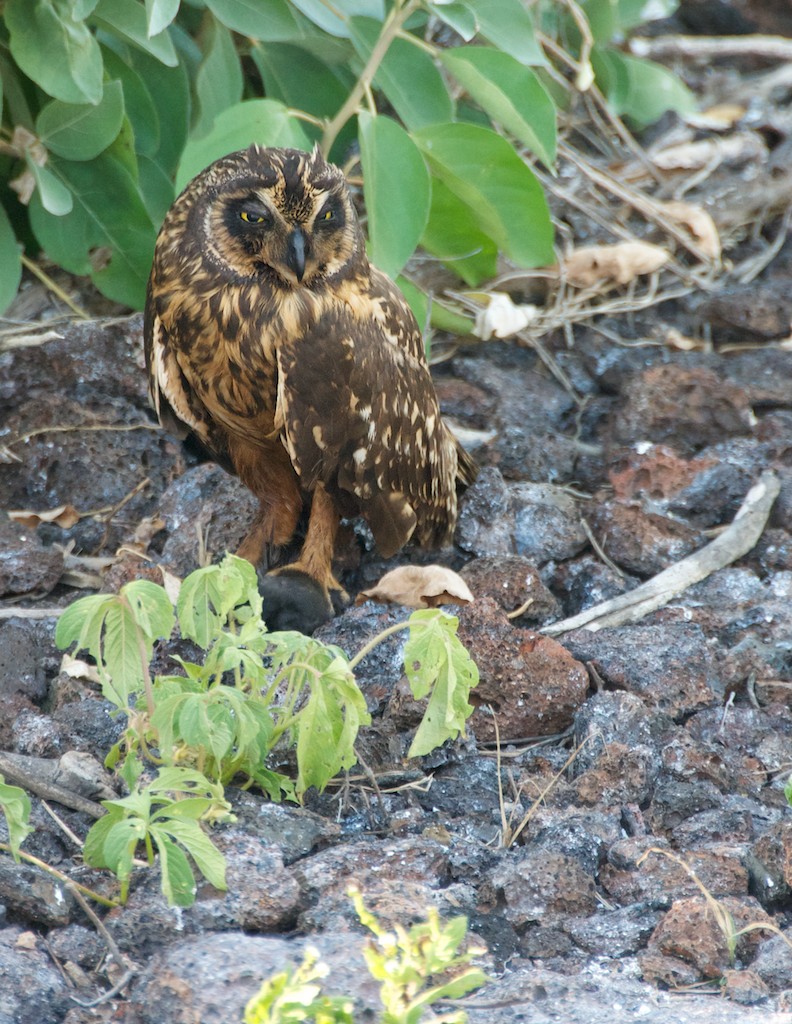
Short-eared owl


Galapagos sunset

Sunday, March 13, 2011

Rio Grande Valley


Altamira oriole
     When our good friends from northern NY e-mailed us to tell us they had arranged for a time-share condo in the southern Rio Grande Valley and would like us to join them, it took us all of 15 minutes to get on the phone and start making plane reservations.  This is the kind of offer birders don't think twice about, you just seize the moment and do it!  The Lower Rio Grande Valley is a mecca for birders.  You can find species here that you'll never see anywhere else in the United States of Canada.  Add to this the number of "visitors" which fly across the border and you've got the makings of one wonderful week of birding.  Our only regret was that we were only going to be in Texas for the one week.  So many locations, so many species, and so little time!  That being said, we certainly made the most of what time we had, visiting 10 great birding locales in 5 and a half days.  We brown-bagged our lunch so that we could eat on site while birding.....didn't want to miss a second of this wonderful opportunity.
Green jay

     We began on Sunday morning with a visit to Sabal Palm Grove Preserve.  This site is right on the border of the US and Mexico.  In fact, you have to pass through the infamous steel wall to get to the preserve.  One of the docents there told us that many visitors turn around at the wall thinking they are illegally crossing the border.   Well, we weren't deterred by that ominous wall and continued to the parking lot of the preserve.  At the preserve's center, a small building adjacent to the parking lot, we met Andreas, a staff biologist, docent, and student at UT in Brownsville working on his Masters in Ornithology.  He was the perfect contact to meet on our first day.  We had already received great information from several of our birding club members back in New York as to the "must see" sites in south-east Texas, but our new friend refined our search for birds and gave us further excellent advice.  What a way to start our trip.  

 The "front yard" of the office was comprised of a small patch of bare ground under the lush canopy.  Feeders and water features were present as were orange halves stuck on the limbs of the trees.  Within the first half our of our first experience in birding Texas, we had 8 "life-birds": the Altamira oriole, Green jay, Olive sparrow, Long-billed thrasher, Golden-fronted woodpecker, Buff-bellied hummingbird, Black-crested titmouse, and Great-tailed grackle.  A trip out to the "Resaca" or 0x-bow lake gave us many more birds including a new NA lifer, the Least grebe.  On the way back to our home base, we stopped at the University of Texas - Brownsville campus and added the Neotropic cormorant to our life-list as well as the Couch's kingbird.  Ten life birds on the first day was not a bad way to begin our Texas birding experience.