Monday, October 22, 2012

Day 295: October 22nd – Down Under


Sunny, mid 60s with a light breeze

       No, there is no error in the heading of this blog.  Yesterday was the  20th and today is the 22nd.  In the middle of the night we crossed the international date line and lost the 21st.  Where it went, I do not know.  But I do know that here in Melbourne, Australia, it is Monday, the 22nd of October.

       After a 16 hour flight and a couple more hours getting through Customs and Immigration, we are finally here in beautiful Melbourne.  This is truly a fine cosmopolitan city with clean streets, friendly inhabitants, and some fine birds!  I really didn’t think that taking a walk in the middle of a city, I’d pick up two new life-birds. 


       Down here, of course, these are “junk birds”.  They are seen all the time and everywhere in the city, but for me, they were lifers and that’s all that counts.  The first (and there were dozens of them!) was the Silver gull.  With a pure white body, white tail, and gray mantle, the bird also sports deep red legs, bill and eye-ring along with a light colored iris.  The bird is really difficult to mis-identify, and for a gull, that’s saying something in my book.

       Next to be found was the Magpie-lark.  I’ve got Magpies on my list as well as larks, but this was a new bird for me.  The one I found along the banks of the Yasso River, was a female.   The fact that there is no white above the eye as there is the both juvenile and adult males makes it so.  Another beautiful bird which the folks here in Melbourne take for granted.


       While not a lifer, the Common myna was a nice addition to the Australia life-list.  Walking along the river bank not too far from the Magpie-lark, this bird paid me little heed as I approached and moved around the bird to get better lighting on the subject.  I haven’t had a myna since Florida, so this was a nice addition to the “year-list” as well.


       Finally, I have to add a Common starling to the Aussie life-list.  The bird was sporting a great deal of white spotting and a bright yellow beak, so it was obviously in breeding plumage.  Even if we see the European version back home, this bird was welcome and added to the total count of this brief. 


       Finally, it was off to our room to get a few hours of shut-eye after being awake on and off most of last night (a 16 hour night at that).  Tomorrow, we’ll visit one of the Botanical Gardens here in Melbourne and we should be able to pick up a few more “Urban lifers”.  The great thing about this past-time is that no matter where you are and what time of year it is, you can always go birding!


Saturday, October 20, 2012

Day 294: October 20th – Mission Viejo


Overcast and cool mid 60s, calm

     
        A much different day today re the weather as it has become cloudy and cool.  Even the hummingbirds have gotten a late start at the feeders.  Still, once the first hummers showed up, they onslaught began and it was not uncommon for the rest of the day to find a dozen birds at the two feeders all at once.  Again the two common species were the Allen’s and the Anna’s.

Anna's hummingbird 
       I retraced my steps of yesterday, reversing direction and following the local trail behind our hosts home.  The trail follows the ridge of a canyon and has plenty of good habitat for birds such as the California towhee.  This bird was a “lifer” for me and I was thrilled to find it foraging along the edge of the trail.  Not the most spectacular bird as far as color, but it certainly serve the purpose of blending in with the surroundings.  The bird stayed close to the edge of the trail and was able to dart back into cover.  Noting the sightings of the Cooper’s hawk yesterday, it was probably a good idea that Mother Nature worked out this color scheme for the towhee.

       By far the most dominant bird of the day was the American crow.  They were in constant motion moving up and down the canyon and calling to one another non-stop.  Another bird of note which unfortunately was not very cooperative about showing up for an image capture while I had the camera close at hand was the Black phoebe.  The Phoebe showed up on several occasions, perching on the fence surrounding the pool.  The first time, we were in the water and obviously could not get to the Nikon in time.  Later, he showed up for a shot by our host, but was gone by the time I got outside.  I watched all day in the hopes of capturing a shot for the blog, but it just wasn’t in the cards. 

       Tomorrow, I’ll be reporting to you from Melbourne, Australia.  Hopefully, we’ll get to the Botanical Gardens and have some new birds to introduce to you at that time.  For now, it’s off to board the plane and fly for 16 hours.  Not looking forward to that, but…….

Friday, October 19, 2012

Day 293: October 19th – California Birding


Sunny, low 80s, light breeze

       A couple of days of simply relaxing before we head out to “Down Under” on Saturday night.  Our hosts while we are here in Mission Viejo have a couple of hummingbird feeders set up in their backyard and Sharon and I are quick to take advantage of this opportunity to add a couple of “year-birds” to the list.  We have a lot of activity at these sources of nectar and the action lasts the entire day.  We have constant visits from two species….the Anna’s hummingbird and the Allen’s.

Anna's hummingbird
Allen's hummingbird
       Later, we took a short hike through the development in which our hosts live.  There is a nice little trail that runs behind their place and we decided to see if there were any west coast birds to add to our trip list.  Low and behold, not only do we get a new year bird, but the Bushtit we found are new to our Life-list!  A flock of about a dozen or so are flitting from tree to tree.  Deep in the foliage for the most part, a female finally comes out into the open and give me the opportunity to get the bird added to my Life photo list.  An unexpected treat!

       Next are a couple of hawks to add to the trip list.  The first is a trio of Red-tailed hawks which fly in fairly close and give nice extended views.


       Later, a Cooper’s hawk flies overhead and like the Red-tail gives us good looks.


       We head back to the house to take advantage of the pool and hot tub in the hopes of loosening up a tight back before we head out on our 13 hour flight to Australia tomorrow night.  Tomorrow, we still have a few hours to get in a little more west coast birding.  What a nice way to begin a great adventure to the southern hemisphere!

Day 292: October 18th – The Shape of the Land


Sunny, cool 60s, light SE winds

       We are off the ground and headed for Long Beach, California as I write this entry.  We will be in the air for a little over 5 hours before we reach our destination.  After a two day stay in the Golden State with hopefully a few new “yard birds” to add to the year list, we’ll head out to Australia and New Zealand.  We’ve been in Australia once before, but that was in the BB era….before birding.  We spent almost the entire two plus weeks in the Sydney area and really love it.  This time, however, we’ll be touring a great deal of the country and should be able to bag some new avian additions to our life-lists. 


      As we fly over the Great Plains in Nebraska, a myriad of ponds and lakes dots the landscape.  The flood plains of the meandering streams supply the farms with rich alluvium which is the life-line of the folks that live out here.        


       The “Upland Trough” becomes visible as we pass into Wyoming.  The change in drainage patterns can be seen even at our elevation of 35,000 feet.  
  

       Eventually, the plains begin to undulate as the foothills of the Rockies take over as the dominant landscape.  The snow-capped peaks of the Rockies can be seen looming in the distance as we continue west through Wyoming and Colorado.


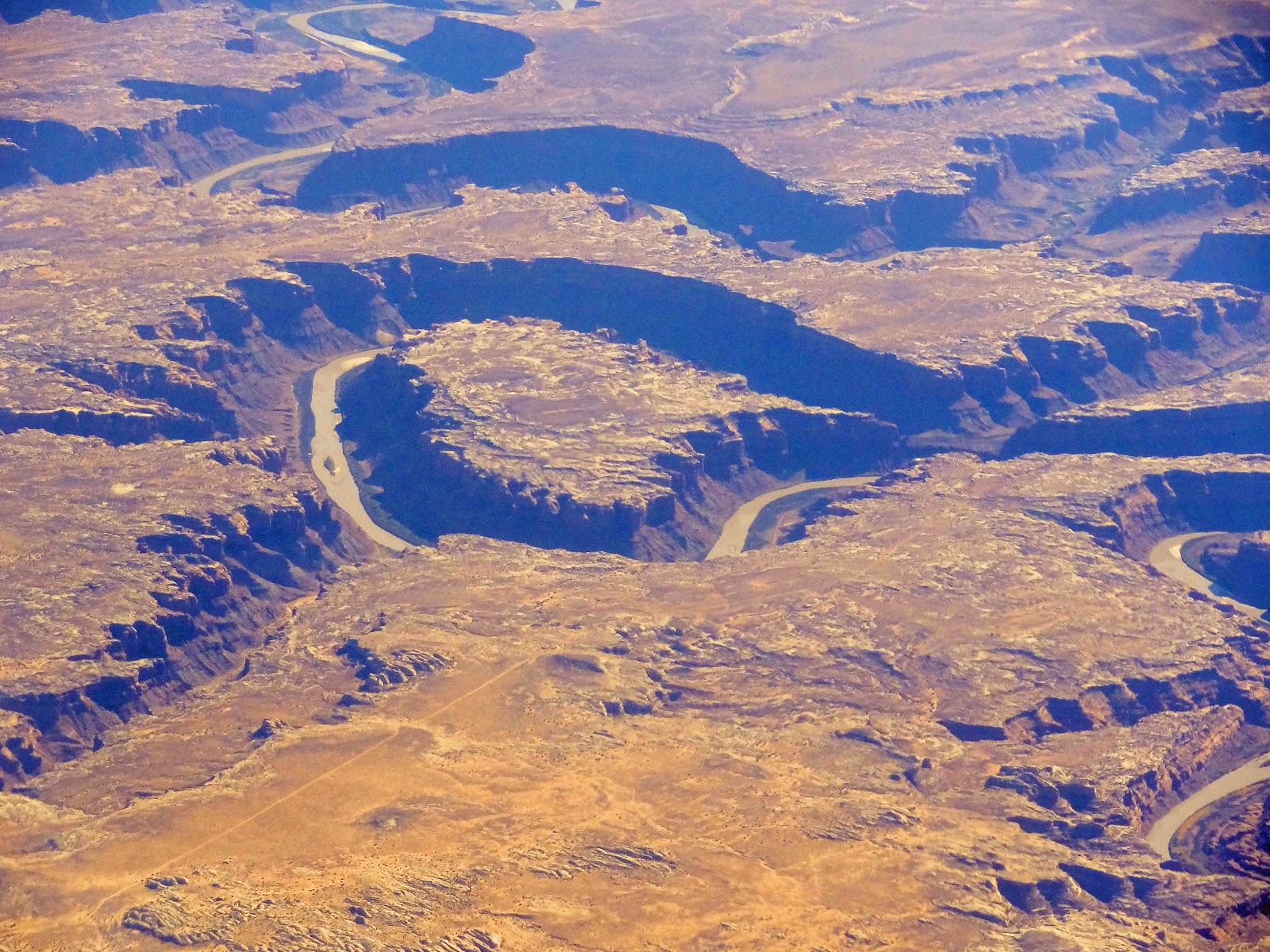
       Passing into Utah, the topography changes again as we find mesas and buttes punctuated by deep valleys and dendritic drainage typical of these landscapes.


       Next, we find the Colorado plateau and the incised meanders which cut their channel downwards as the land rose.

       As we pass into Nevada, the landscape changes yet again to the desert lowlands of the Basin and Range province.  These downthrust blocks of land are actually below sea level and and result in some of the most arid regions in the country.


       Finally, we reach the Pacific Highlands stretching out to the  “left coast”.  A spectacular view which portends what lies ahead, albeit on a totally different continent.  We are all anxious, but we are pleased to have a couple of days here in California to regroup and prepare for the rigorous journey ahead.


Wednesday, October 17, 2012

Day 291: October 17th - Hawks in autumn


Sunny, cool, and a light se wind

       A brief entry as a picture is worth a thousand words.  It’s fall on Bear Mountain and that means HawkWatch.  We’ve had a number of blog entries on this magical place already this year, but today’s shot sums up what a beautiful and majestic place the mountain is.  This same scene is played out on hundreds of mountain tops across the eastern U.S. as the hawks migrate southward.  Today’s shot is of the main species moving across the mountain today, the Red-tailed hawk.  This photo is special for Sharon and I as we head west tomorrow to California on our first leg of our journey to Australia and New Zealand. Come along and enjoy the adventure with us!  For now, let’s enjoy autumn in New York.


Tuesday, October 16, 2012

Day 290: October 16th- Gadwalls and Shovelers


Sunny and brisk with a gusty NW wind

       
       One of the keys to a successful bird photography outing is to have a target in mind.  It doesn’t always work out that way, but if you can hone in on a target species and an appropriate habitat, you will increase your chances of getting the shot you want.  Usually, if it does work out, there tends to be a little extra gravy in the form of another desirable shot that you kind of blunder into.

       Well, one of my birding buds informed me that the ducks were starting to show up in Rockland Lake recently.  Sharon and I had checked that site a few weeks ago and had some nice resident Wood ducks, but we were hoping to get some of the migrants moving through.  So, with those environs and Gadwalls in mind, I headed south.  An alternative motive for visiting the lake was the fact that I strained my back on Saturday and was not all that ambulatory today.  Rockland Lake offers some pretty good shooting from the car, so……

       The plan worked like a charm,  As I drove up to the little pond opposite Parking Lot #1, I noticed there were indeed ducks present.  To my surprise, Northern shovelers were present, albeit at some distance.  Still, I was able to brace the camera against the window sill and capture an image of the bird in his early fall plumage.  I mentioned in the blog yesterday that we found mallards all in fine alternative (breeding) plumage down at Iona Marsh.  Well, many of the dabblers tend to get their best fineries in order before the holidays.  Shovelers are a little tardy in that regard, however, and don’t generally get beyond the basic plumage until well into winter. Still, it is a fine looking bird.

       But wait, there’s more!  Fortunately, the Gadwall does not wait until winter to adorn his finest outfit, and here was a male in some of the most striking plumage I’ve seen in some time.  It’s not that the Gadwall is brightly hued.  Actually, it the contrast of his patterned gray body, light chestnut wings, black rump and brilliant white speculum which make him so attractive.  As nice as their plumage is, it belies the nasty habit of waiting around for a diving duck of a different species to surface and then snatching the morsel form its target’s bill. 


       Each day now brings in new and exciting migrants and winter residents to the Hudson Valley.  The evolution of the local avian assemblage is just one more aspect of what makes this pastime of birding so enriching and so interesting.

Monday, October 15, 2012

Day 289: October 15th – Weather fit for ducks….


Rainy, calm and mild 69

       On many rainy days while working on this blog, I find myself wandering over to Iona Island Marsh.  On many days, it is dependent upon the tide as to what birds you’ll find working the flats.  A good deal of work has recently gone into restoring native vegetation and removal of phragmites in an attempt to lure what use to be here back to these environs.

        While the habitat looks so much better and so much more attractive for birds like rails, marsh wrens, and ducks, the results have been certainly short of stellar.  But, that being said, it takes time to restore habitat and time for the birds to rediscover it.  With that in mind, today was a turn in the right direction. 

       We always expect to find mallards in the marsh, but what made today special was the number of pairs we found with males in bright breeding plumage.  After all, this is the season in which males and females will pair up.  Some of the males seen today were rising up out of the water, flapping their wings, and whistling and grunting.  The males will no doubt follow the females to the breeding grounds when the time comes.


       Along with the mallards were several Black ducks.  These ducks look quite similar to the female mallards, but they are darker and have a bright yellow bill, lacking the mottling seen on the bills of female mallards.  These ducks tend to stick around during the winter and are known to remain on territory further north than most migratory ducks.


        Finally, while not a duck, the best sighting of the day was an American coot.  These ducks are not all that rare here in Orange County in the fall, but they have been hard to find here at Iona in the past.  Perhaps the new look of the marsh is enough to begin enticing more of these “rail-like” birds back to these grounds.  Let’s hope so!


Sunday, October 14, 2012

Day 288: October 14th – Grackles and a Hermit thrush


Sunny, high of 70, a light breeze

       I began the day checking out my two mixed seed feeders which I filled only the day before yesterday.  They were now both completely empty and my first thoughts turned to those pesky squirrels.  Both of these feeders are among the more “squirrel proof” that I have, however, and I was at a loss to explain the depletion of the feeders by culprits other than the rodents.

       All of a sudden, in flew a flock of grackles…..a few pilfering what little remained on the trays of the void feeding stations and the rest making a feast of the pile of seed which had been strewn onto the ground.  It was suddenly very obvious that these birds had raided by feeders, spilling all but the last remnants out onto the ground and then making a clean sweep of the detritus on the ground.  I should have known that this was the probable cause since I’ve run into the practice by the grackles in years past.  Generally, the only way around it is to leave the feeders empty for a week or two until the grackles grow tired of the sparse offerings and move on.

       As we headed out to our grandsons’ weekend ballgames, we stopped off at the Subway sandwich shop along the way to pick up lunch.  Here we had out second photo-op of the day, a handsome Hermit thrush.  I shot the photo seen here, but now I have to be perfectly honest.  I played the avian photographer’s counterpoint to the famed Civil War photog Matthew Brady. 

       Brady managed to capture some startling photos of the horror of the war, often by moving the corpses of the soldiers into a more dramatic setting.  Well, when we found this poor thrush, he was actually on the sidewalk, an apparent victim of a window strike.  Obviously, he had not been there long and still looked very much alive…..except that he wasn’t.  With a little careful creative posing, I took the liberty to memorialize the bird as he was in life rather than the tragic end that he endured. 

        Bird deaths resulting from window strikes are estimated to exceed 970 million individuals each year!  Only deaths by feral and domestic cats comes close to this as far as “unnatural” deaths are concerned.  A sad end for a beautiful bird.


Saturday, October 13, 2012

Day 287: October 13th – Not so common birds today


Sunny, cold (30s) calm day

       Back to Benedict Farm in Montgomery today with the Mearns Bird Club to see if we could pick up any new sparrows or other “winter birds”.  The day was quite successful with not only plenty of sparrows but also a few birds that we don’t see that often in these parts…..at least at this time of year.

       Regarding the sparrows, we did manage to pick up a couple of nice Lincoln’s sparrows which our Orange County Check List considers to be “Uncommon” in autumn.  According to the key at the beginning of this check list, “uncommon” means not easily found in the proper habitat”.  Well, we were definitely in the “proper habitat” today, and we did find this fine looking specimen.

       Next on the list of our not so common species was a Bobolink.  This bird also earns the classification of “U” in the checklist in Spring, Summer, and Fall and is most uncommon in late fall when they should be moving out of the area.  The bobolink has a complete change of wardrobe as we move into the fall and looks nothing like he does in summer.  So when this bird showed up today, he was an “automatic” as far as inclusion into today’s blog.

       The Rusty blackbird is another bird which is uncommon in autumn and rare in winter.  As far as this birder is concerned, the rusty is even more uncommon than the others we found today.  It’s white iris sets it apart from other blackbirds and is always a real plus to see on any of our outings.


       We also had a few other species of uncommon nature that I was not able to capture on film, but are worthy of note.  The White-crowned sparrow is a sure sign of impending winter and we did in fact have several sightings of this handsome sparrow.  From a distance too great for the 400mm lens I was using but easily identifiable through the 10X bins, we had several views of Eastern meadowlarks, a nice find for this late in the year.  Finally, we had a number of Pine siskins which were featured earlier this week in the Naturally Digital Blog pages.  All of the folks in today’s birding group agreed that this has been a banner year for the siskins regarding how early they have shown up and how many have made the appearance.

       And so, the ensemble continues to change, almost on a daily basis.  Late summer is considered to be the “doldrums” of birding in the northeast, but mid to late fall more than makes up for it.  We have plenty more in store for us in the upcoming months, so stay tuned!

Friday, October 12, 2012

Day 286: October 12th – Quick trip into Connecticut


Overcast with periods of rain, chilly mid 50s, calm

       We had a short time to check out a couple of sites on our way to our son’s house in Connecticut today.  One of our favorite spots is River Road along the Shepaug River in Southbury, CT.  While it is far too early for migrating eagles to be at the dam and along the river (a favorite haunt in winter), there are several fields and ponds and well as the river in which we might find some early migrating ducks or other water birds as well as sparrows.

       At first, our best prospect for a shot worthy of blogness was the Northern mockingbird.  In spite of their being one of the more common birds in our part of the country and the fact that we can become jaded, a close look at these birds shows that they are indeed one of the more handsome members of the bird world.

       The catch of the day, however, was a group of 8 Wood ducks swimming amongst the duck weed on one of those ponds I mentioned.  With little to no vehicles on the road at this time of year, I had plenty of time to stop the RAV in the middle of the asphalt and shoot away.  Even though the light was subdued and the ducks were distant as Wood ducks often are, I was able to set the ISO down to 400 and fire away.  The result was at least one decent documentation shot of these most beautiful of ducks.


       Perhaps only the Harlequin duck can compete for sheer brilliance of ornamentation among the waterfowl community.  Even in the rainy atmosphere, the colors of the woodies are so brilliant you can’t miss them even at this distance.

       And so, while not a great variety of shots today, the Wood ducks surely fill the bill as our Shot of the Day.


Thursday, October 11, 2012

Day 285: October 11th – Early siskins


Sunny, autumnal skies, NW winds with temps in the mid 50s

       The Pine siskin is a small finch closely resembling the American goldfinch in size but much more striped in appearance.  The siskins are normally found in the boreal forests of Canada, New England and northern New York during breeding season.  These little finches are normally a rare to occasional visitor to the southeastern corner of New York, but this year, they are rolling through in big numbers.  Not only are the numbers greater than normal, but they are here much earlier than would normally be expected.


        The finch forecasts for the northeastern United States this winter predicts a higher than normal incidence of these birds due to an unusually poor pine cone crop in Canada.  When these shortages occur,  a “bumper crop” of crossbills, redpolls, and yes, Pine siskins can be expected to visit the southern half of the Empire State.


       At our home, we have a number of feeders which we keep filled for much of the year.  Siskins are truly a rarity here, for whatever reason, but not so this year!  Last night, I glanced out to check the activity at the feeders and found no less than two dozen of the little finches feeding at the thistle feeders, the sunflower seed platforms, and on the ground below the mixed seed dispenser. 

       What a treat to have these visitors from the north so early and in such great numbers.  Today, they were still around albeit in fewer numbers.  Hopefully, we will find that these little guys will stick around for much of the winter.  We’ve said it before and we’ll say it again.  You just never know what to expect in the natural world.


Wednesday, October 10, 2012

Day 284: October 10th – Riverfront birding


Cloudy and rainy with temps in the mid to upper 50s

       Birding along the Hudson River’s waterfront is somewhat predictable depending upon the season.  In winter, a wide variety of ducks join the swelling population of visiting Bald eagles and make for some very interesting birding.  At times, during the fall migration, thousands of swallows will gather by water’s edge as they make their way south.  Today was much more typical of a lazy fall day, however, with the standard avian assemblage.

       Things you can always count on at the waterfront….gulls.  At this time of year, the dominant species is the Ring-billed gull.  Smaller than the Black-backs and Herring gulls which will be prevalent all winter long, the Ring-bill is easy to identify.  As the name implies, the tip of its bill is circumscribed with a black ring.  Hundreds of these gulls were found along the water’s edge, in the parking lots, and on the river.  As expected……


       Also as expected, there were ducks.  Unlike the winter assemblage, however, the collection of ducks here today consists of one species, mallards.  With the exception of  few “domestic” ducks (many of which will readily breed with the mallards),


 there were no other ducks to be found along the entire quarter mile stretch I scouted today.  The Common mergansers, Canvasbacks, Buffleheads, and Hooded mergansers which can be found here in December are still hanging out in their summer digs and cannot be found here quite yet.


    Even the songbirds are precious few here today.  The omnipresent Northern mockingbird does show up for me and give a nice pose sitting upon a split rail fence near the ferry terminal.  Several others were also here today, but they were all unexpectedly silent.  Generally, you can hear them way before you ever see them, but today, for whatever reason, they have elected to sit quietly and watch the goings-on at the wharf.

        Last (and perhaps least) is the ubiquitous Rock pigeon.  Virtually everywhere in the world can be called home to a population of pigeons.  And yet, as common as they are, they still are quite handsome in their varied array of iridescent feathers.  Perhaps we all get a little jaded about this bird which is often referred to as a “trash bird” because of its commonness, but I do know that others are quite fond of the pigeon…namely kestrels, Cooper’s hawks, Eagles, and so on.  They must be tasty little morsels if you are a predator looking for a squab dinner.


       Time to call it a day.  We will revisit the Newburgh waterfront later this winter to see what shows up to spice the place up a bit.  Until then, we’ll have more than enough new sites to keep us busy.


Tuesday, October 9, 2012

Day 283: October 9th – Sparrows at Benedict


A mix of sun and clouds with a chill in the air

       Every day seems more and more autumnal as the hours of daylight fade and the accompanying cool temperatures make their presence known.  With the change in weather, we await the changing cast of characters in our avian production.  Winter will bring a new group of birds such as juncos, siskins, and White-throated sparrows.  Today, as the changing hues of the season portend these changes, we head over to Benedict Farm in Montgomery, NY to see if any of the changing of the guard has begun to take place over there.
Song sparrow

       For the most part, we see the sparrows we’ve found at Benedict for most of the spring and summer.  Many have undergone a recent molt, however and appear “fresh” with subdued and yet “cleaner” plumages. 

Savannah sparrow
       The young birds may not yet look quite like their adult conterparts.  Take these juvenile House finches, for example.  Their plain gray lightly striped appearance will help them blend in with their surroundings, a definite plus as the leaves begin to fall and will offer little in the way of cover in the next month or so.

       Our only “winter bird” today is a “first of the season” White-throated sparrow.  Soon, these will be regulars at our home feeding stations.  It’s so nice and almost rejuvenating to see our winter guests begin to arrive. 


       I’ll begin to refill all of our feeders in the hopes of attracting some of these birds to our yard.  With plenty of food to go around in summer, I generally keep only one or two feeders filled, more for my own enjoyment than for the welfare of our feathered friends.  In winter, once the snow falls and the naturally seed supply becomes more scarce, the birds will welcome the additional supplies.  For now, however, as in summer, the extra feed with sate my “hunger” more than theirs.