Sunday, May 19, 2013

2013: Week 20- “Break-a-hundred”


A “Big Day” of birding in Orange County

       This week was one of preparation for and then execution of a “Big Day” of birding here in Orange County.  A “Big Day” crams as much birding as possible into a 24 hour period and it usually produces some great numbers of species and an equally great number of exhausted birders.  Our birding club, The E.A. Mearns Bird Club” of Orange County New York holds their event every May at the peak of warbler migration when the weather is usually quite pleasant.   The still young leaves have not yet emerged to the point that the trees can hide each and every bird within their boughs making for some exciting viewing of these most beautiful North American birds.


       This year’s  “Break-a-hundred” as our event it known was one of our best with 80% of the teams managing to find at least 100 species in the 24 hour period.  The winning team actually was able to find and identify 140 species…..a remarkable feat!  So, what is it like to compete in a Big Day?  Our event began at 4:00 P.M. on Friday afternoon.  Our team gathered at one of our members homes at about 2:00, gathered all our birding paraphernalia, loaded into three vehicles, and headed out to our first site…..Iona Island in Harriman State Park.  The idea is to orchestrate the day so that you cover as many different habitats which will hopefully produce as many different species of birds as possible.  Iona is a marsh which we were counting on producing rails, shorebirds, perhaps egrets and herons as well as gulls, possibly terns and others. 

       Precisely at 4:00, we began checking off the species we could see from that point on….no species seen prior to the official start time count until the clock has started ticking.  Before the start, we had seen three Greater yellowlegs, a shorebird, in several locations of the marsh.  Of course, once the contest actually began, the bird had disappeared.  It took almost another hour to relocate this species, but in the meantime we had already racked up almost two dozen species….a decent start.
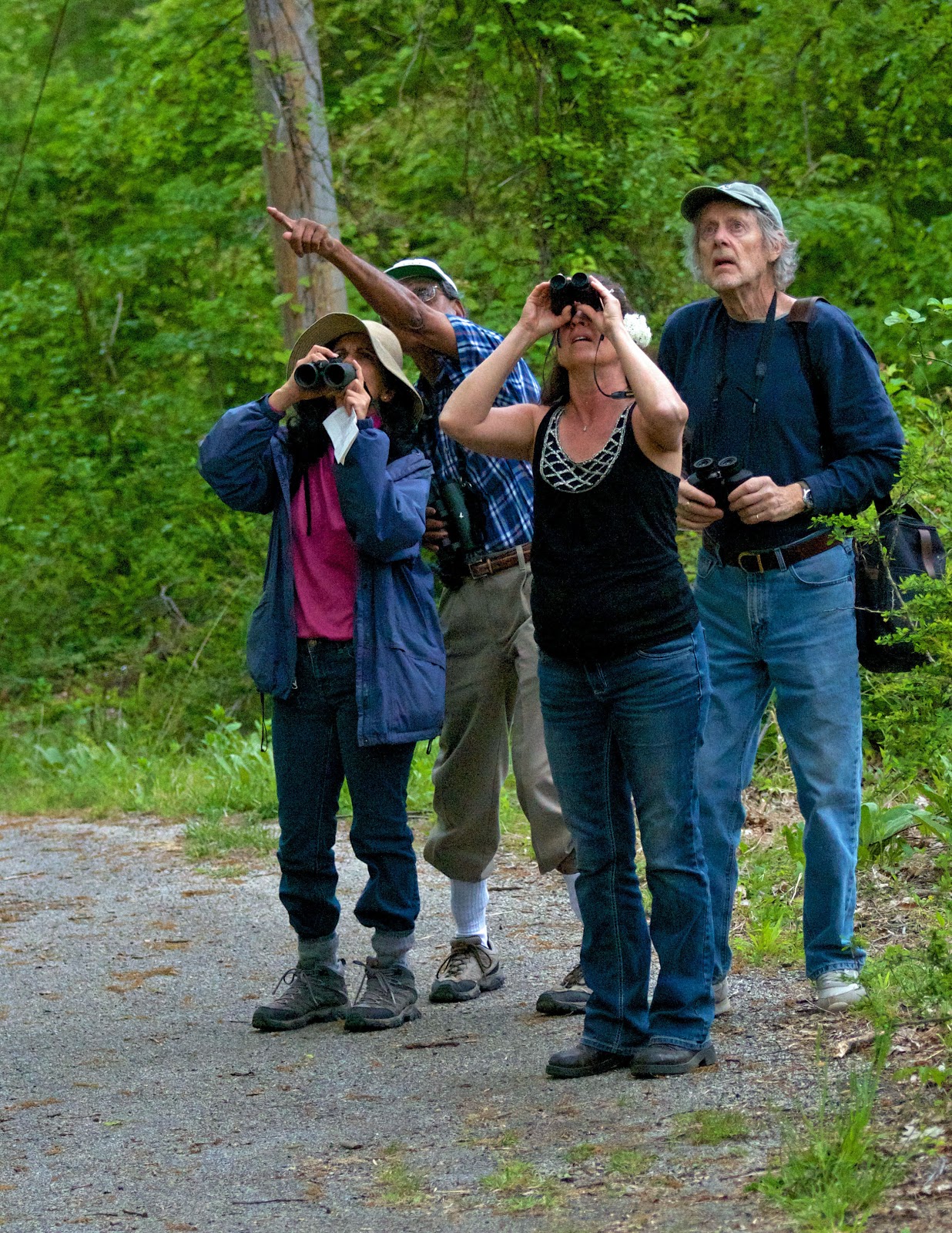

      When we figured we had exhausted the possibilities here at the marsh, we moved up into the upland forests of Doodletown.  A historical location near the marsh, the now deserted town has little to indicate that it was once a thriving community other than some disappearing roadbeds, old stone walls, and ornamental plantings from the time it was taken over by the state in the mid-60s.  Now it serves as an oasis for many of the warblers migrating north during the month of May.  As the team hiked through the property, we heard many songs of the warblers as well as actual sighting of a good number of the birds.  Most accomplished birders can identify a bird by its song as well as by its outward appearance.  A couple of hours here gave us a respectable number of birds for the first day, but of course the day was only beginning.  We still had about 21 hours to go!

       Among the birds found at this site were the nemesis bird for many of the teams, the Olive-sided flycatcher (left).  This bird perches atop the highest snags and should be easy to spot.  And yet, the bird is usually located more by his call of "Quick-three beers!" before he is seen.  So it was today as we were one of the few teams to be lucky enough to come across this species.

       We also added a nice Spotted sandpiper here below the dam.  Sitting in the shade alongside the outflow, he was well camouflaged and if it were not for the keen eyes of one of our observers, we well might have walked right by without seeing him.

Spotted sandpiper
       When we departed Doodletown, the sun was setting as we headed over to an area known as Mine Road where we hoped to get a few species that become more active in the hours of twilight.  There was the hope of garnering a few owl as well.  Mixed success met us at this site.  The Whip-poor-wills began singing loudly as the skies became darker as did the Wood cock, but nary a single owl was willing to add its name to our checklist.  By 9:30, we decided to head back home and grab a few hours of rest so that we could be on site and birding as the sun rose tomorrow morning.

       We reconvened at 3:30 A.M. and headed out to our next birding venue, the Bashakill Swamp.  “The Bash” as it is known has long been a birder’s paradise and is exceptionally productive during the spring months.  We knew we could also count on Eagles and Ospreys here as it serves as nesting territory for those two species.  As the sun began to rise the unmistakable call of the American bittern joined the chorus of Red-winged blackbirds, Wood ducks, Common gallinules, and Great blue herons. 
 
"The Bash" at 5:00 A.M.
        Swamp sparrows, flycatchers, vireos, and the prized warblers would be joining in soon, so we had to move quickly.  If you are lucky, you can see more than 20 species of these brightly colored birds including this gorgeous Magnolia warbler.  Some warblers are easy to find and you can count on checking them off fairly early in the day, but others like the Nashville, Cape May, Bay-breasted and Mourning warblers are much more difficult to locate, however, and are thus more revered in the birding world.  By this mornings end, we had more than 20 warbler species on our list. 
 
Magnolia warbler       
        From here, it was up into the higher country where we were looking for birds like the Dark-eyed junco, Winter wren, Raven, and Yellow-bellied sapsucker (yes, there really is such a bird!).  We were shocked when we came up short with only the raven being added to the list.  We move down to the reservoir where swallows were a possibility, but even here we could only find the Rough-winged swallow which we already had bagged earlier.

        A local Boy Scout Camp offered a mixed hardwood forest with some tall pines and in the past we had see the exquisite Blackburnian warlber (known familiarly as the “fire-throat” because of his brilliant orange throat patch).  Here we did succeed in finding the target, but we had to move on.  The hours were passing, and as the day wore on it was harder and harder to add new birds to the growing list.

        We returned to the Bash to visit a couple of spots we had left unbirded earlier in the day.  We were rewarded for the effort with several other warblers, the Golden and Blue-wing warblers.


Blue-winged warbler (archival shot)
       Now it was time to head back to the wetlands in an effort to clean up with a few marsh birds like the Sora and any sandpipers we could locate.  We were headed for Oil City Road on the New Jersey border and then back to an area near Goshen known as 6 ½ Station.  Up until now, the weather had cooperated nicely with partly to mostly sunny skies, calm winds and warm temperatures.  But Mother Nature decided to give us a more memorable send-off, so the final two hours were played out in rather rainy and chilly conditions.  While the Sora eluded us, we did pick up several nice sandpipers at a 6 ½ Station.  It was here we finally tallied the Pectoral sandpiper as our final species of the 24 hour period. 

       All competing members, about 30 of us, joined together to a count down the numbers of species each group had located.  Our team had a respectable 126 species which would have won in many of the past years.  Today, however, it was only good enough to take third.  Still, it’s not really about the win (yeah, right?) but rather about being together with great friends in this beautiful world of ours and completely being immersed in a pastime that means so much to so many of us. 

       Next week, Sharon and I will continue to chase the migrant warblers as we head to south Jersey for more great habitat and even more great birds.  See you next weekend to tell you all about these latest adventures.

Sunday, May 12, 2013

2013: Week 19 – Migrants finally moving


May 5th – 11th

       A rain abbreviated week will insure that this week’s blog will be a bit shorter than normal.  We found ourselves taking short trips out to local sites whenever the clouds parted for a few hours.  Still, in spite of (or more probably because of) the unsettled weather, the migrants we have been eagerly anticipating have finally started to drift in. 
 
       On Sunday,  Sharon and I drove out to Mine Road to check the “hot spots” and see if our warblers were finally arriving.  It’s been a relatively slow spring, with the usual May visitors coming to the party fashionably late.  But arrive they did and we had several nice sightings of the front guard.  Our first were a group of warblers at the gate to a site along the road known as “Area U”.  We used to be able to hike well back into the forest here and it was always productive.  Since homeland security as become such a big issure over the past decade, much of the property has become posted and as such is off limits to us birders.  It’s the price we have to pay, I suppose, but it is West Point property and if they say stay out, we’ll abide by that.  From the roadside, however, we did pick up our first nice warblers of the season.  A beautiful Blue-wing let its presence known with its “brrr-buzzzz” song and we quickly caught a look through the bins. A bit frustrating in that it kept its distance and was not caught on camera, but it was recorded in the mind’s eye if nothing else. 

       A  bird flitting high up in the canopy was likewise out of camera range, but we could see that it was a fine Blackpoll warbler.  Hooded warblers, yellows, and Common yellowthroats were joining in the chorus and it was beautiful music to be sure.
 
Blackpoll taken in 2011
        Further along at a site we call the old sand piles, we had even better views of the Blue-wings.  Again, restricted to the roadside, we still managed to get closer views as one of their number scooted from one side of the road to the other (see photo below).  Later in the week, with a group from the Mearns club, we found the blues again, but this time accompanied with a lone Golden-wing….what a gorgeous bird!
 
Blue-winged warbler
       All in all, between the two days along Mine Road, we recorded around 35 species, many of which were first of the year birds. 

       One migrant which appears to have gotten lost, waylaid, or just happy to hang out was a Red-throated loon which had been reported lingering at the Croton Point Park beach on the Hudson.  The bird should probably be on its breeding territory up in Northern Canada or the Arctic.  But for whatever reason, here it was, swimming along diving, and seeming to have a good old time here in the Hudson Valley.   We’ll watch to see if it sticks around for much longer.


       Finally, again between storms, we took a ride out to Ironwood Road in Sterling Forest State Park.  The area has long been known as a reliable spot for Golden-wings and other warblers in May, so we were hopeful at getting another look at this beauty.  Rather slow again, but at least with some trekking up the power line right-of-way I was able finally to see the bird clearly. Again,  quiet and as deliberate as I could be, I could not approach anywhere near enough to get a decent shot, so I’ve included one of my shots from last year to display why birders work so hard to get a look at the Golden. 
 
Golden-winged warbler (archival shot)
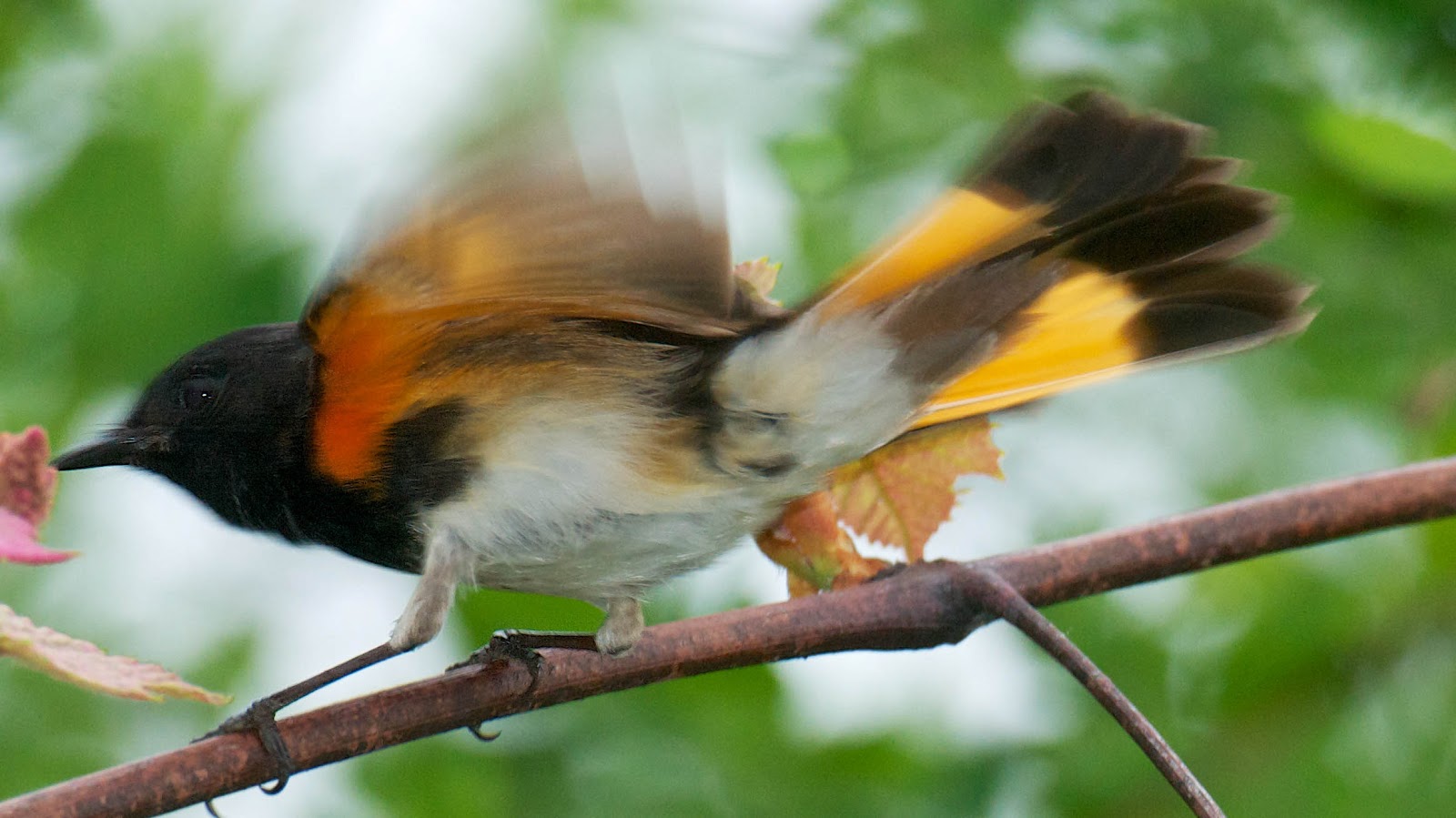
       While down at the power line we did get some other nice looks by sitting in the car down at the end of the road and simply waiting to see what birds sand or flew into view.  In such manner, we had Common yellowthroats, Yellow warblers, a Blue-wing, and a number of Redstarts.  One of the redstarts perched above the RAV and allowed me to get my first photo of the year of this handsome bird. 


       Eventually, the bird decided we were not all that interesting and took flight, making for an interesting photo of the bird in motion.


       Well, now that the birds are here and the weather my begin to clear, we will try to get out for more of the warblers and have some good birds to report on next week.  Until then……

Friday, May 3, 2013

2013: Week 18 – East Coast Refuges


April 28th – May 4th

       Each year as we head back to the northeast from our winter quarters in Florida, we take our time and make an attempt to visit several National Wildlife Refuges.  We managed to visit four of our national preserves en route although one was an abbreviated stop due to adverse meteorological conditions.

       Our first stop was in the state of Georgia….the Harris Neck National Wildlife Refuge.  The 2,824 acres of this park remind us of one of our favorite areas back in New York, the Shawangunk Grasslands, in that both refuges were at one time WW II airfields.  Harris Neck was established as a refuge in 1962, the park is made up of  salt marsh, open fields, forested wetland and mixed hardwood/pine forest habitat and as such is home to many resident and migrating birds throughout the year.  We’ve been visiting this refuge at the beginning of May for some years now and have come to expect  seeing certain species..  The park has a somewhat inauspicious entrance gate with a small parking lot (not unlike other NWR venues).  The road leading down to the Visitor’s Center should definitely be walked and not driven as that quarter of a mile can yield a plethora of wonderful sightings One such sighting this year was the Summer tanager.  As soon as we emerged from our car, we heard the richer raspier “robin song” associated with this bird.  Sure enough within a few minutes we found the bird singing this song and managed to get a clear view.

       We also had nice FOY views of the Red-headed woodpecker as we walked the road along with a White-eyed vireo singing from an isolated shrub and easily viewed.  Other birds we commonly see along this stretch of dirt road are the Brown thrasher, Painted bunting and Northern parula.


       As we continued on the loop around the refuge (there are over 15 miles of paved roads and trails within the confines of the park), we came across many nesting Wood storks, herons, egrets, gallinules and this feeding anhinga.  Those catfish have some wicked spines, and the bird worked hard at first stunning the fish by beating it against the branch below it, and then flipping it around until it could get it into the “safe” head-first orientation. 


       As the thunderstorms began to roll in, we took one quick look at one of the impoundments adjacent to the old airfield and found Bobolinks flitting about the meadows.  We know we’ll find these up at our “airfield refuge” later this month, but these Bobos were the first of the year and a treat to see.


          From here, we continued north to South Carolina and Santee National Wildlife Refuge.   Located on the shore of SC’s largest lake, Lake Marion, the reserve was established back in 1941 and is now comprised of over 13,000 acres of managed lands.  This is also one of those places we “always” visit on our trips down to and returning from Florida.  


       As we entered the park early on Tuesday morning, we made a stop at the VC to see what birds were taking advantage of the feeders.  We found House finches and grackles along with the beautiful male Painted bunting.  We’ve had some nice sightings of this bird down in the sunshine state, but this may be the last view we have in some time, so we relished this splendid specimen.

       One bird we always hope to see here is the Prothonotary warbler.  A boardwalk winds its way through the swamps of Wright’s Bluff, a perfect habitat for these beauties and sure enough no sooner did we draw close to the swamp than we could here the ringing “tweet-tweet-tweet-tweet” call of the bird.  As we walked the swamp, several individuals flew overhead and perched to check us out. 


       As we photographed this striking warbler, fellow birder Joe noticed a large bird flying into the swamp at some distance.  Easily seen we found it to be a Barred owl.  The bird was not alone as it began its resounding series of “Who cooks for you?” and was quickly joined by the response of a second owl.  The two continued to converse back and forth long after we had left the boardwalk and the swamp.  The sound was almost ethereal as we walked along the trail on this cool misty morning.

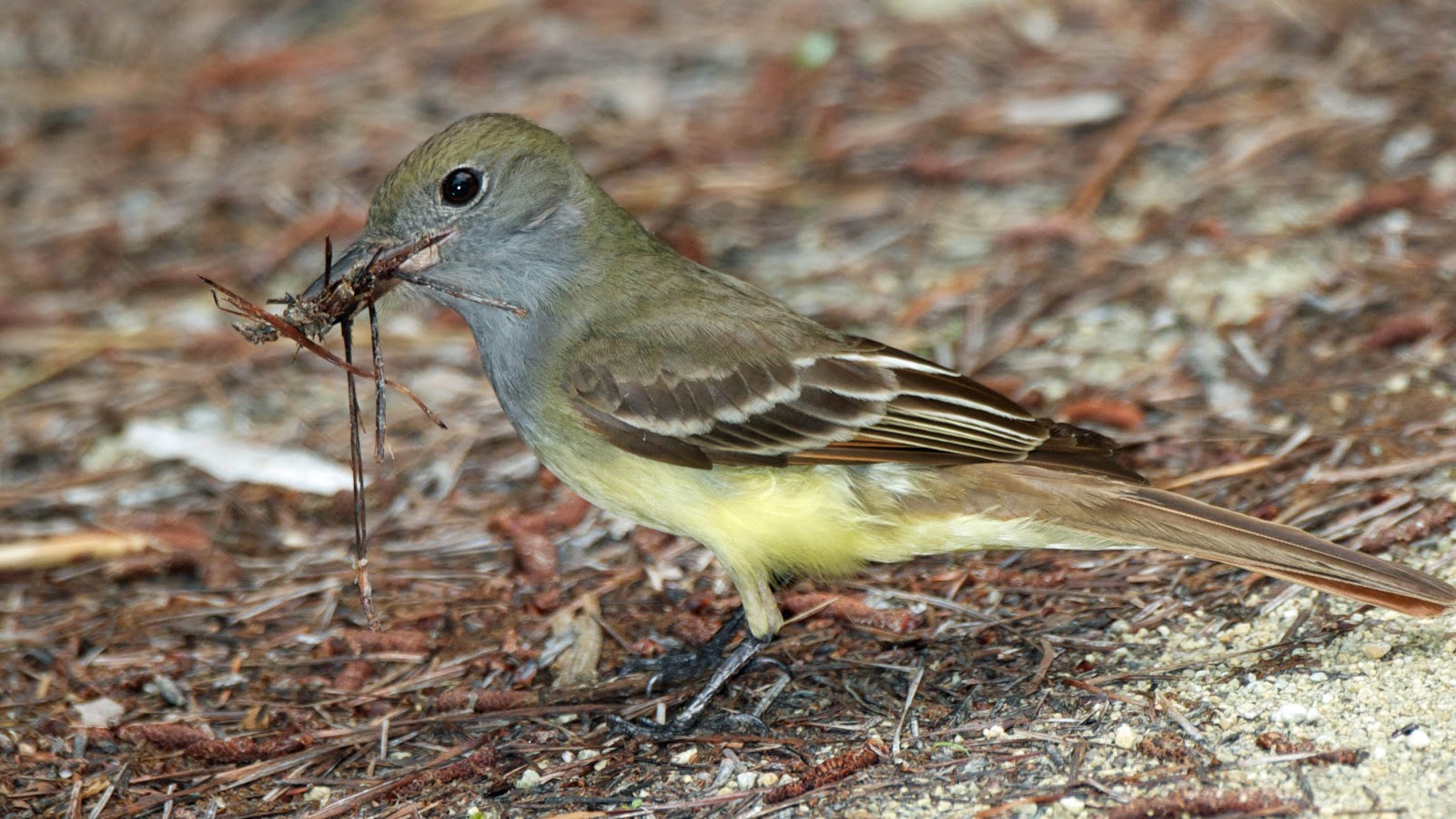
       While exiting Santee, we came across one last bird of note.  Throughout the day we had heard many Great crested flycatchers calling from the tree tops.  We had even seen a few, but none so close as this individual which was obviously on the nest.  Actually, the bird was on the road getting ready to return to the nest.  As we slowly drove by, the flycatcher simply held its ground until we were on our way and they flew up to the nest.  Quite a sight!


        We still had miles to travel on this day, however, so we headed north for Virginia.  The next morning, the plan was to visit the Eastern Shore of Virginia NWR, and we did make a brief stop.  Mother Nature was not fully cooperating this morning, however, so Sharon suggested that we continue north towards more welcoming weather and another of our favorite birding sites, Bombay Hook in Delaware.  And so, off we went.       About four hours later, we drove onto Whitehall Neck Road in Smyrna, Delaware.  Strange that our journey began three days ago in New Smyrna Beach, Florida and here we were at a refuge in a town with a similar abeit not that common name.  Anyway…..

       As we entered the preserve, we found the feeders were attracting Goldfinches, Red-winged blackbirds, and White-crowned sparrows.  Tree swallows were making use of the bluebird houses and the Martin houses were over-crowded with purple martins.  It looked like we were going to pad the year-list nicely at this refuge.

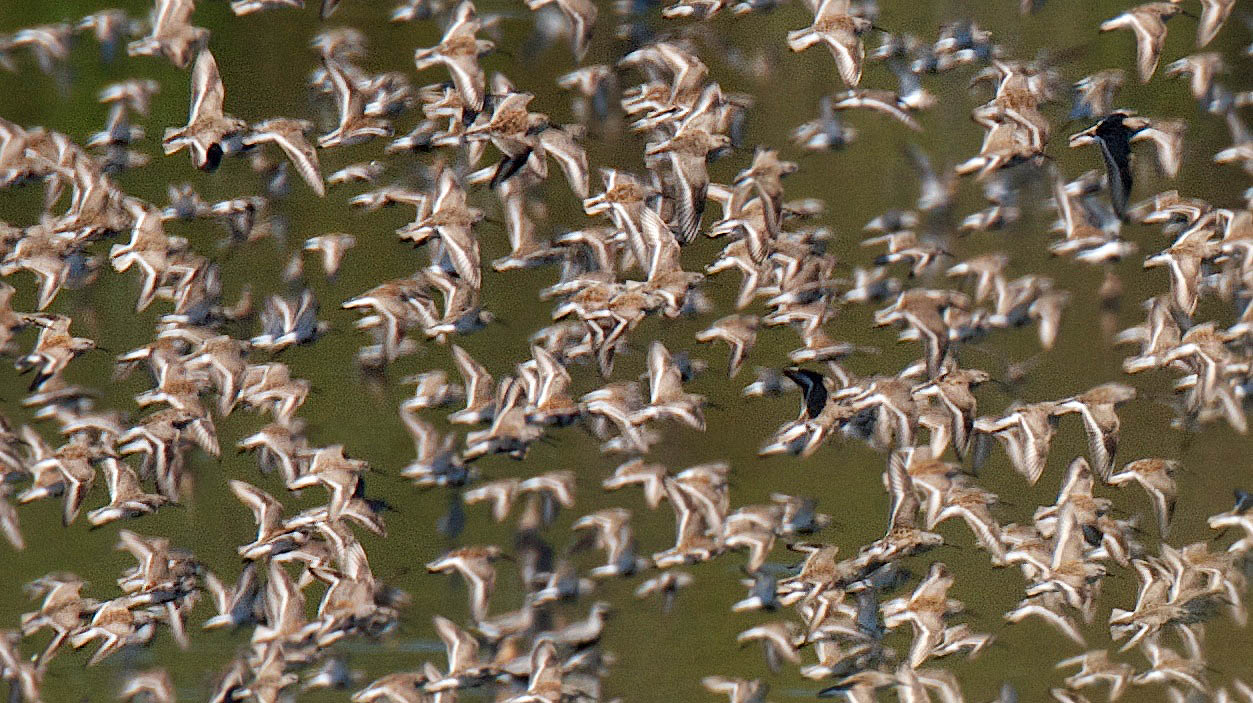
      Shortly after leaving the Visitor’s Center, there is a parking area and a short trail to an observation tower overlooking one of the large impoundments.  When we arrived….what a sight!  Easily fifteen hundred Dunlin packed into the shallow water of the ponds, shoulder to shoulder.  Every so often, something would cause the myriad to rise en masse, make a quick flyover and then alight back into the water.  How they managed to all move in such synchronicity without crashing into one another is yet another wonder of nature.  Sprinkled in among the dunlin were quite a few Black-bellied plovers and both these plovers and the dunlin were well on their way to sporting their full breeding plumage.  Gorgeous!

       As we drove the loops and walked throughout the trails, we found many signs of spring and the nesting season.  Walking out to the marsh where we hoped to get our first Clapper rail of the year, we were surrounded by chattering House wrens.  We may have been getting too close to their staked out territory for their own comfort, so we quickly moved on. 


       Just down the trail, we found Tree swallows doing what Tree swallows should do….setting up their nesting site in a tree!  We commonly see these swallows nesting in bluebird boxes and other bird houses, but it was nice to see them actually using a natural cavity to nest in.


       When we finally made it out to the observation deck, we heard our second wren species of the day the Marsh wren.  We also heard the Clapper rail we were hoping for, but like the Marsh wren, it was heard but not seen.  Back to the car to continue our way around the refuge.  We had heard reports of one last bird we really wanted to find before we departed and made the final leg of the journey home.  Although no specific directions were offered, someone had posted finding a Tundra swan on the refuge.  We carefully were checking each and every body of water we came across, but to this point we had not found the bird.  Time was running out.  But a swan is a big bird!  How could we miss it?   As luck would have it, on the last impoundment we checked, there it was.  A white blob far out on a sand bar in the middle of the pond just had to be the swan.  We definitely needed the scope, but sure enough there was no mistaking this swan for anything but the Tundra.  A great way to end the visits to four of our national treasures….the National Wildlife Refuge system.

       We’re back in New York and the Hudson Highlands once again and it’s just the beginning of warbler season.  Next week, we’ll be out and about in search of these little gems.  Until then……

Monday, April 29, 2013

2013: Week 17-Last week in the Sunshine State


April 21st  – 27th

       Well, it’s the final week of April 2013 and we wonder “Where have these first four months of the year gone?”  It seems as if we just arrived and headed down to the Space Coast Birding Festival….but that was 3 months ago!  It’s been a great year with such rare highlights as the Vermillion flycatcher, White-cheeked pintail, Thick-billed vireo, Cassin’s kingbird, Spot-breasted oriole, Gray kingbird, Western kingbird, Long-billed curlew, and the Ash-throated flycatcher. We added six new life-birds while here in Florida and visited several new preserves we had never birded before.  So….in summary, it’s been a wonderful productive 3 ½ months.  But we still had one week left, and so we took a last run down to Merritt Island to see if we could pad the numbers.

       At Merritt, we ended up with just under 40 species on a chilly, windy and drizzly day.  The numbers are down as many of those species so common in the earlier part of the year have done what we are about to do….head north.  We did not come across a single species of duck!  Waterfowl are so abundant down here in January that you cannot look upon the waters of a single impoundment without spending an hour combing through the throngs to pick out each and every new species.  Coots numbering in the thousands during January and February were non-existent today.

       There are numbers of certain species which are increasing as we enter into spring, however.  Spoonbills seem to be more numerous than previous months.


       The number of tri-colored herons was very high today.  It seemed that every open body of water was home to several of the species.  Many are sporting their newly acquired white plumes, typical of the breeding season. 


       The Eastern kingbird, absent for the past three months, is happily once again on territory, a summer resident across most of the United States.  As the spring and summer wear on, these birds will become more and more common.


       One other quite common species was also found in some abundance at Merritt this week.  Unfortunately, it was the feral hogs that were out digging through the soil cover in search of grubs and roots.  These mammals have become a major pest in the southeast, doing considerable damage to forest, meadow and roadside habitat.  When they move through an area, they leave behind plots of land that literally look as though a backhoe had been used to excavate the land.  They are being hunted in an attempt to “cull the herd”, but they are prolific breeders and we now see them almost every time we visit Merritt Island.

       Later in the week, we drove north to Washington Oaks Gardens State Park in Palm Coast.  With some strong north winds accompanying stormy weather for the past couple of days, we had hoped to find migrating songbirds taking cover here in the heavily wooded gardens.  Sadly, we did not find too much we did not already have.  We did locate Prairie, Black and White warblers, and our old buddy the Northern parula.  The parulas are prevalent in the early spring in Florida, truly one of the harbingers of the season.  I had one of my closest encounters with one at the gardens as the bird flew in within a couple of feet of me and landed in a shrub…checking me out as much as I was him. Normally, these little guys are difficult to see clearly as they prefer to forage in the canopy of the live oaks, often feeding and hiding in the Spanish moss which adorns the limbs of these massive trees.  At such close proximity, it was amazing to see exactly how tiny these warblers are.  Many of these little beauties will join Sharon and me as we head north next week, and we look forward to seeing or at least hearing them in the hardwood forests of the northeast.

       Later in mid-week, we had yet another chase as a Neotropic cormorant had been reported along Biolab Road back down in Merritt Island.  The directions were pretty explicit, so we hopped in the RAV and headed south.  We scouted out the first possible cite and came up with many Double-crested cormorants in various plumages.  Several of the breeding males had the tell-tale crests which in spite of their name are not seen very commonly.  Plenty of other species were around, but try as we may, we could not “morph” any of the DC’s into the desired Neotropic.  But we persisted, and as luck would have it, we eventually spotted a noticeably thinner and smaller cormorant perched on a piling right where the rare bird alert posting had noted.  Out came the scope and sure enough, we got the visual confirmation we wanted…..our first Neotropic cormorant in several years and the first we ever had in Florida.  This sighting was doubly sweet as we had chased the bird earlier this year  down to Wakodahatchee Wetlands in DelRay Beach and came up short. 


Dark morph Short-tailed hawk
        Finally, on Friday night we decided to go for one more rarity.  A member of the Halifax Audubon, Steve, had reported sightings of multiple Swallowtail kites and the very elusive Short-tailed hawk at Central Park in Ormond Beach (naturally when I plugged the park into the POI’s of the GPS, it wanted to send me back to NYC!)  We found the park and we found Steve ready and willing to give us the guidance we needed to find the birds.  Early on, we had a quick sighting of what we believed to be the Short-tail.  Unfortunately, the view was brief and the one shot I could get was back-lit, but it sure looked like the quarry we were after! Later examination of the photo(s) by a local expert in the field (chief ornithologist for the Marine Science Center at Ponce Inlet) confirmed this sighting!


       The grand finale came when the Swallow-tailed kites Steve had promised finally arrived. And what a show they put on!  First one, then another, then several more all sailing gracefully as only kites can do right over our heads and out over the lake.  As the sun was setting, we had 14 kites visible at the same time, kettling, then peeling off only to rejoin shortly thereafter.  It was truly and avian air show being staged as if totally for our exclusive enjoyment.  What a way to wind down our three and a half months here in Florida!


Saturday, April 20, 2013

2013: Week 16 – “Two out of three ain’t bad….”


April 14th – 20th

       As we count down the days until our return to the Empire State, we still have some unfinished business down here in Florida in regards to unrecorded sightings.  Three glaring omissions on the year-list for us include the Bachman’s sparrow, the Red-cockaded woodpecker, and the Brown-headed nuthatch.  By this time last year, I had all three in the bag and had actually seen the nuthatch on several occasions.  With only a little over a week, it’s time to scramble to see if we can finally get these birds.

       One area nearby could possibly yield all three of these targets, so Joe T and I hop in his Prius early on Friday morning and head out to Christmas, Florida.  What a great name for an area known to give out some wonderful birds as presents to those who bird Orlando Wetlands, Hal Scott Preserve, and Tosohatchee Wildlife Management Area.  We’re going to begin at Hal Scott, a sight known for all three of our quarry.

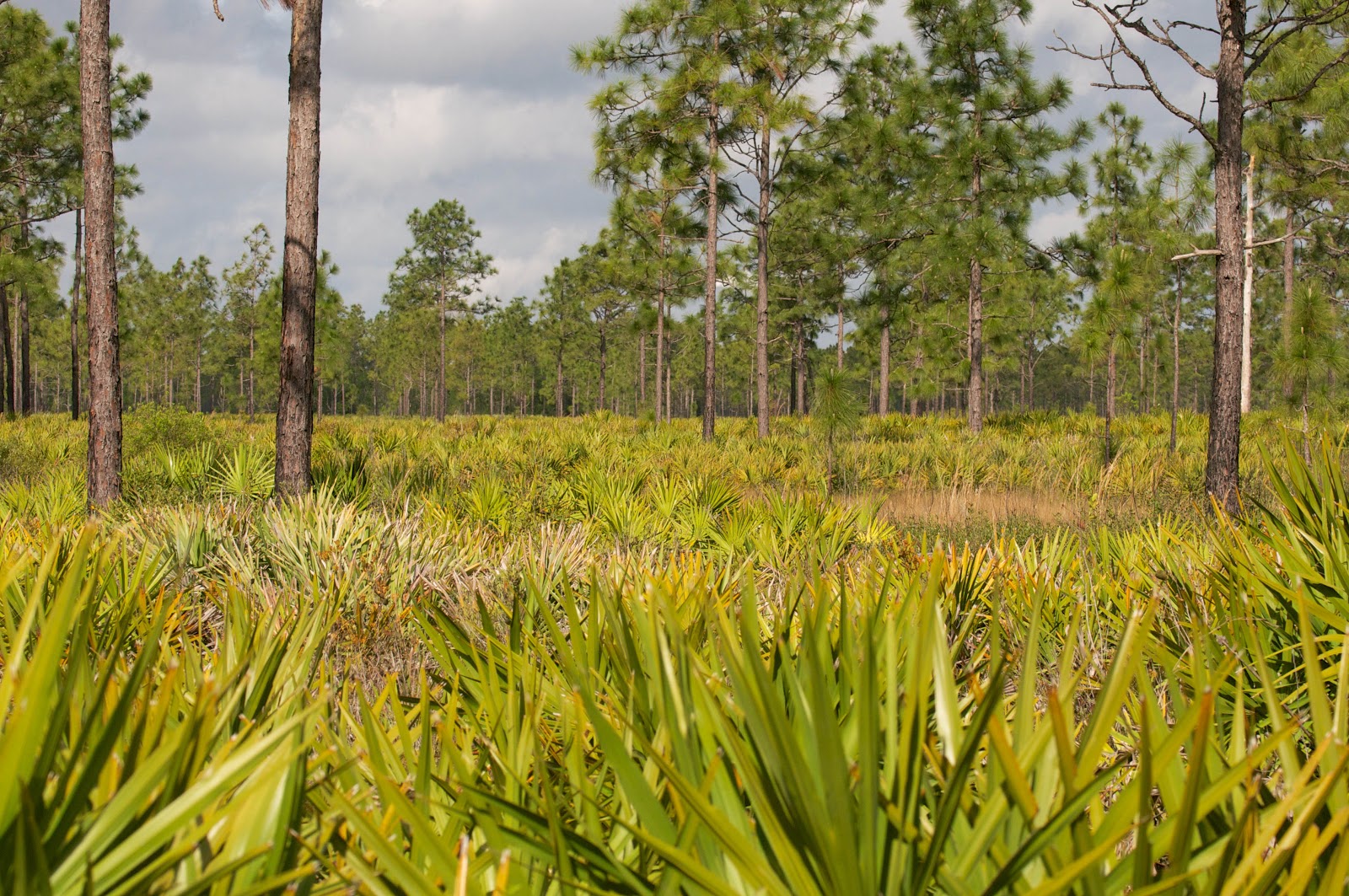
       Hal Scott has a pretty decent sized prairie of mostly palmetto and grasses.  The Bachman’s sparrow prefers mature pine forests with grassy understory.  The bird spends most of its time down in the grasses, popping up onto a low hanging pine branch occasionally to sing.  Unfortunately, much of this habitat across the southeast has been developed, and this sparrow has adopted to nesting in brushy open fields.  This is the habitat we are searching today.  The song of the Bachman’s is pretty much unmistakable, and at this time of year, the song is easily heard as the males begin staking out their nesting territory.  Our job was to hike through the vast fields and stop and listen every so often for the whistles.  Then, we carefully follow the song to its source and watch for the bird to pop up on a low branch.  That’s our photo-op. 


       Well, the birds were present as promised and we did find some handsome individuals singing throughout the prairie.  Finally, our first Bachman’s sparrow of the year.  Sadly, with habitat loss, the bird is becoming more rare and is believed to be declining in numbers.  Hopefully, the acquisition of more and more of the remaining prairies by local, state, and federal governments to protect these lands will help preserve the remaining stock.


       One down and two to go.  Next up, the Red-cockaded woodpecker.  This bird is known to nest in the Hal Scott Preserve.  To “guarantee” sightings, however, you have to be here at either sunup or sundown to see them leaving and returning to their nesting trees.  Like the Bachman’s sparrow, these birds prefer large tracts of mature pine forest to thrive.  Unlike the sparrow, however, they do not easily adapt to changing environmental conditions and have therefore seriously declined in number over the past years as their habitat has been removed and natural fire has been suppressed.  They are now considered an endangered species with less than 10,000 individuals remaining across the southeast.  The photo provided here is one I took several years ago since we did not have any luck finding any today.  Hopefully, next winter we will once again be privileged to catch a glimpse of this beautiful species.
 
Red-cockaded woodpecker (2010 archive)
       With no luck finding the woodpecker nor the nuthatch at Hal Scott, we moved onto the Tosohatchee Wildlife Management Area several miles to the east.  The Brown-headed nuthatches have used this area as a breeding ground in the past, and we can only hope to find some of these little foragers.  Like our two previous targets, these birds love the pine forests, although they do not need the more extensive forests that the Red-cockaded woodpeckers require.   This little nuthatch is the least numerous of all our North American nuthatches, but still seems to be holding its own in the remaining pine forests of the southeast. 
 
Brown-headed nuthatch
      Once again, we had to walk through a considerable amount of acreage of sparsely vegetated pines stands before we finally heard the chatter of the nuthatches.  They are generally found in small groups or at least in pairs, so when you find one, you’ll find more.  As a group, their vocalizations make for quite a chorus, so when finally located, it is easy to follow the song to its source.  Up in the canopy and then working their way down the trunk in typical nuthatch inverted orientation, they provided us with nice views of our second target bird of the day.

       And so our day ended with one other notable sighting.  A shaft of light through the hardwood forest we passed through at Tosohatchee fell upon a strange couple….a Broad-headed skink and a Southeastern five-lined skink entwined as other skinks I have observed mating.  I seriously doubt that these skinks were that confused (although the Broad-head had the red face typical of breeding time).  Why these two were found together like this, I have no clue.  I glanced away for just a few seconds to make an adjustment to the camera settings and the five-line was gone.
 

       Well, we scored on two of our targets today and as Meatloaf sang out in one of his more popular hits…..”Two out of three ain’t bad”.  With one week left to try and get out for a final couple of final Florida birds before we head north along with our fellow avian migrants, we’ll see what few new species we can add to the year-list which now stands at 208.  Our goal is to reach 200 different birds by the time we return north, so that plateau has been reached and puts us on a good track in an attempt to get past 375 for 2013.  After returning to New York, our next major new territory to explore will be a July trip to North Dakota and the “potholes”.  We are looking forward to the next few months after three great birding months down here in the Sunshine State.

Sunday, April 14, 2013

2013: Week 15 – South Florida rarities


April 7th  – 13th

     Last week, I mentioned that it was a pretty quiet time bird-wise and that we were looking forward to a major birding trip this week down to the Miami area and the Everglades.  It turned out to be more than we ever expected.  We missed only one major target bird….the Mangrove cuckoo.  That truly would have been a major find, but it was not to be.  Friends had located the bird just last week and one of them, Joe from our New York birding club,  was with us as our “guide” for the three day tour.  Nonetheless, we had excellent weather (albeit pretty warm with highs in the 90s) right up until our departure time on Saturday when we were hit with some powerful thunderstorms. 

       We left New Smyrna, our winter quarters, on Thursday bright and early.  Our first goal was to reach Wakodahatchee Wetlands in DelRay Beach by around 8:30 in the morning.  Targets included Black-bellied whistling ducks, sora, Least terns, and Purple gallinule.  Although we scored on the ducks and the gallinule, we missed the other two.
 
Black-bellied whistling duck
      
Purple gallinule

       
       Not to worry as we did pick up the first-of-the-year terns later in the trip.  A bonus, however, was the appearance of the Least bittern.  I had heard this elusive bird several times during our travels around the central part of Florida, but visual contact was never made.  Finally, as we walked the boardwalk, Sharon almost jumped off the trail and into the impoundment as she called out the bittern.  We saw it land in a mangrove close to the boardwalk (I mean REALLY close!).  As we slowly approached, we could see the bird peeking out to see who it was that made all that commotion as it flew by.  Joe and I quickly snapped off a few shots before the bittern returned to its normal habits and disappeared into the heavier cover.   What a great way to begin our three day trip!

       After a couple of hours of checking out the myriad of birds at Wakodahatchee, we headed south for Chapel Hill Preserve just outside of Fort Lauderdale where our lone target bird was the Purple swamphen.  Without too much exertion, we found the bird browsing among the grasses of the swamp.  It preferred to keep its distance and was nestled in the vegetation to such a degree that it was had to photograph.  I did get a couple of “documentation” shots just to prove we saw it, but it was definitely not “blog-worthy”, so you’ll just have to take my word for this one.  From here, we traveled east to nearby Cooper City and the Brian Piccolo County Park.  Strange as it may sound,  in among the ball fields, skate park, and velodrome are found a good number of active Burrowing owl nests.  Each nest is carefully marked off with “police tape” and the local folks know enough to respect these nesting sites.  We found a picnic table near one of the burrows and proceeded to have lunch while keeping a vigil on the site.  Sure enough, before long, we saw a little brown tuft of brown sticking up above the ground.  He watched us watch him for a while before he ducked back underground.  We found quite a few of these including this one right next to yet another ball field.

       As we photographed this owl, (actually one of a pair occupying this nest), we took notice of the sound of monk parakeets flying overhead.  We followed a pair to a nearby tree and got some nice shots of these birds as well.  There may have been other species of parrots present as they have been reported in the past, but we had a schedule to keep and had to move on.  We continued south down Route 1 to Florida City, our headquarters for the next two nights.  We walked across the street from our Ramada Inn in the hopes of finding White-winged doves and Common mynas.  The mynas were present and added to the check-list, but all the doves were either collared or mourning.    
 
Monk parakeet
       The following day as we returned from the glades, Sharon remembered getting the doves at another nearby motel a couple of years ago.   What the heck.  We figured we give it a look.  Bingo!  There it was perched right out in the open as we had hoped for. 
 
Gray kingbird
      Another bonus!  Joe spotted a kingbird in the trees next to the inn.  He was quick enough to note that the tail was unmarked with the white banding of the Eastern species and thought it might be a Gray kingbird.  The bird eventually flew to a wire where I could get a decent shot of the bird and sure enough it was the Gray…..another year bird!

       But, I’ve jumped ahead of myself.  This day was spent traveling through the Everglades National Park.  As mentioned before, the Mangrove cuckoo was on our A-list of birds to get.  But you don’t always get what you want, and the bird was not to be found.  We did score some great birds here, however, including my life Shiny cowbird and a quick look at the elusive White-crowned pigeon.

       Also of note were the good numbers of birds in a mulberry tree near the marina.  Cape May warblers, a Scarlet tanager, a dozen or so Cedar waxwings, Orchard oriole, and a Black and white warbler. 

       As we scoped out the visitors to the tree, several Swallow-tailed kites made an appearance at low altitude, making for excellent subjects for my newest Nikon lens.
 
Swallow-tailed kite
       
       The final day was spent near and in the city of Miami.  We had several targets, but the premier bird we wanted to find was the Thick-billed vireo, a bird normally found in the Bahamas.  There have been several occasions in the past when an individual has strayed into southern Florida, and we were privileged to be able to travel into Bill Baggs Park in Key Biscayne where such an loner has been sighted for the past couple of weeks.  It took quite a while and quite a number of eyes as a dozen or so birders from locations as far away as Texas, Washington DC and New York were on hand to try and catch a glimpse of this life-bird.  Not only did we finally get a look, but the bird strayed into an opening in the vegetation where many of us got nice shots.  It was definitely won the “Best Bird” award for this trip.

Thick-billed vireo

       While we were waiting for the vireo to appear, several Magnificent frigatebirds flew overhead.  Yet another “year-bird”!


Spot-breasted oriole
       Our final stop before we had to head back “north” to New Smyrna was the campus of the University of Miami.  The target here was the Spot-breasted oriole, often seen on campus lately.  We no sooner got our of the car than we heard the distinctive oriole whistles.  Sure enough, high in a tree-top, there was our quarry.  The bird eventually flew a bit lower to give us a better opportunity for some good shooting.

       The other species we had hoped for (and got!) was the Yellow-chevroned parakeet.  There are quite a few species of parrots and parakeets which over the years have escaped from captivity and are now fairly well established in south Florida.  Sadly, this bird remained distant enough that we could not get a decent shot.  But , three days and 89 species later (including three life-birds) we were ready for the long drive back home.  It’s getting close to the time when we will be heading to our “real” home in New York, and this trip was the perfect way to start winding down this three month long birding adventure.


Saturday, April 6, 2013

2013: Week 14: The Links….


March 31st – April 6th

      The blend of friends visiting from the north, the call of the golf links, and cool chilly and even some rainy weather all added up to limited birding for the Bakers this week.  I did carry the camera with me on the golf course and snuck in a few shots between the multiple shots I took  with the mid-range irons, so it wasn’t really a washout (never actually is!).  The premier shots on the golf course were of the sandhill cranes with their young. 

      Normally, we see the family group of two adults and two colts, but today there was only one little guy.  Hopefully, the second was nearby and had not met with an early demise.  The family units are quite tight-knit with these birds and this time of year, it’s much more common to see a group of four than it is to see a lone crane.

      It’s April and the Swallow-tailed kites are here in earnest.  While not a common bird in any sense of the word, we do see them several times a week when out in the field on a regular basis.  They certainly have a level of elegance about them which makes them stand out in the avian world.  Always a thrill to have one or two pass overhead……


     We actually tallied about 25 species during our three golf outings this week.  White ibises can always be counted on aerating the fairways, and the multiple water hazards attract the ospreys, wading birds, and ducks.  Bald eagles are often seen cruising above the courses as well.  Sharon doesn’t play, but will normally ride along with here bins in hand creating a “course-list” for the day.  It’s one of the beauties of our past-time that you can pursue it just about any time and any place.


       Earlier in the week, on our weekly Tuesday bird-walks with the Marine Discovery Center, we encounted some odd behaviors by some of the birds we found on site.  The first was a Green heron perched on a power line.  It’s normally difficult to find these birds hidden in among the mangroves, but here was this bird perched and calling from a utility line!  As we watched, we realized that there was actually a second heron similarly situated on a line only a short distance away. 


         The second strange view was of Cattle egrets feeding on an oyster bar our in the lagoon.  There were certainly no cattle to be found out on the bar and what these egrets were feeding upon is anyone’s guess. 
 
       We did manage two short visits to two other preserves this week.  The first was at Gemini Springs in Deltona.  We were on our way to a photographic show and reception and had a half hour to kill.  We found plenty of the usual suspects along the shoreline and swimming along the creek….gallinules, coots, herons, etc.  There were also an abundance of Boat-tailed grackles taking advantage of any excess bait or leftover snacks left behind by the local fishermen.   This female approached us as if to ask if we had anything to offer.

       Finally, we visited Spruce Creek in the hopes of photographing a King rail we suspected we could find in the preserve.  We had no problem finding the rails…in fact we located at least 8 of them calling loudly at close proximity.  It was maddening to have them call from several feet away and not be able to locate them in the marsh grasses.  We did catch a quick glimpse of four of them in flight, but as soon as they landed, they were out of sight.  The lone shot before the winds picked up and the rain began to fall once again was of a Snowy plying the muddy shoreline in search of a crab for a snack.

       The forecast for the upcoming week looks to be a bit drier and warmer than this past week and as I just upgraded my old Nikon 80 – 400mm with the newer and much faster version of this same lens, I’ll be looking forward to getting out and putting it to the test.  Check back with us next week for the results…..